
Measurements and equipment
Why Transformers Are Rated in kVA Instead of kW
A transformer can supply different kW at different load power factors while the same kVA rating describes its voltage-and-current duty.
Calculate transformer full-load current →Published 10 October 2026
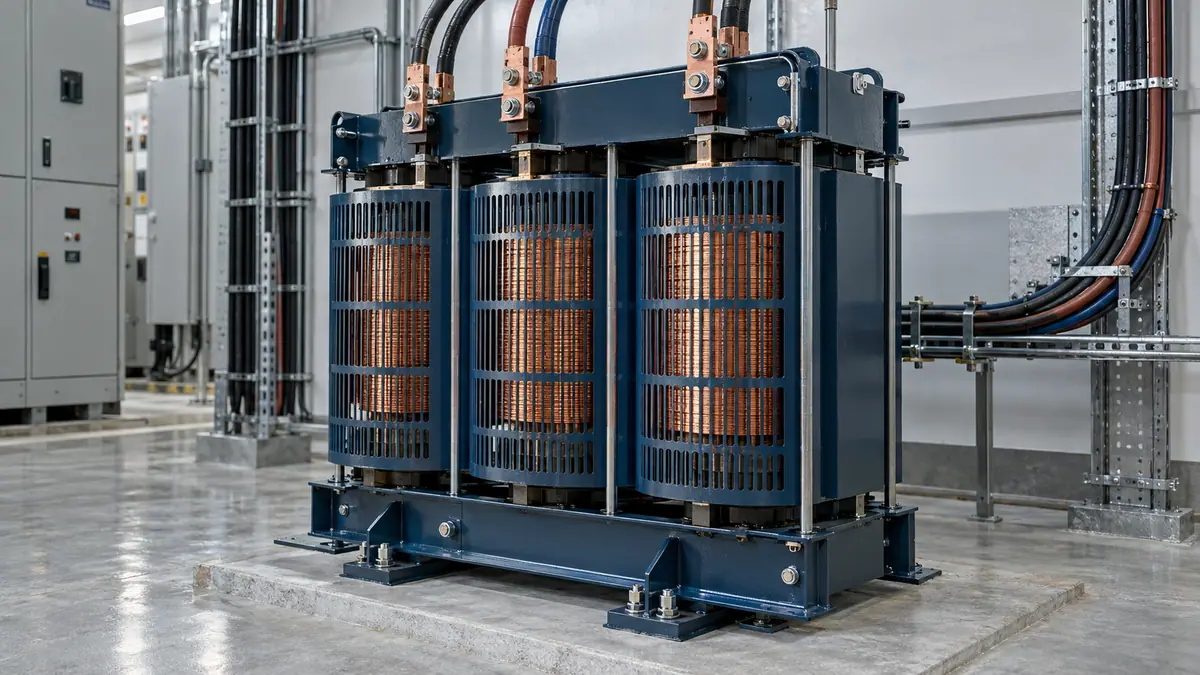
What the nameplate is telling you
A transformer nameplate commonly gives an apparent-power rating in kVA or MVA. The letters stand for kilovolt-amperes and megavolt-amperes. One MVA is 1000 kVA. The rating is related to the voltage and current for which the transformer was designed under its stated conditions. It does not state that a connected load will always take that much power.
The distinction matters when someone asks, “How many kilowatts is a 100 kVA transformer?” There is no single kW answer without the load’s power factor. Apparent power describes the voltage-current product; active power is the portion represented by kW at the operating power factor.
Open the transformer current calculator to convert a nameplate kVA rating into nominal primary and secondary currents. The kVA-to-amps calculator is useful when you need current for just one side at a selected voltage.
The short electrical relationship
For a single-phase circuit, apparent power in volt-amperes is S = V × I. For a balanced three-phase circuit using line-to-line voltage and line current, S = √3 × VLL × IL.
To estimate full-load current, rearrange the three-phase expression:
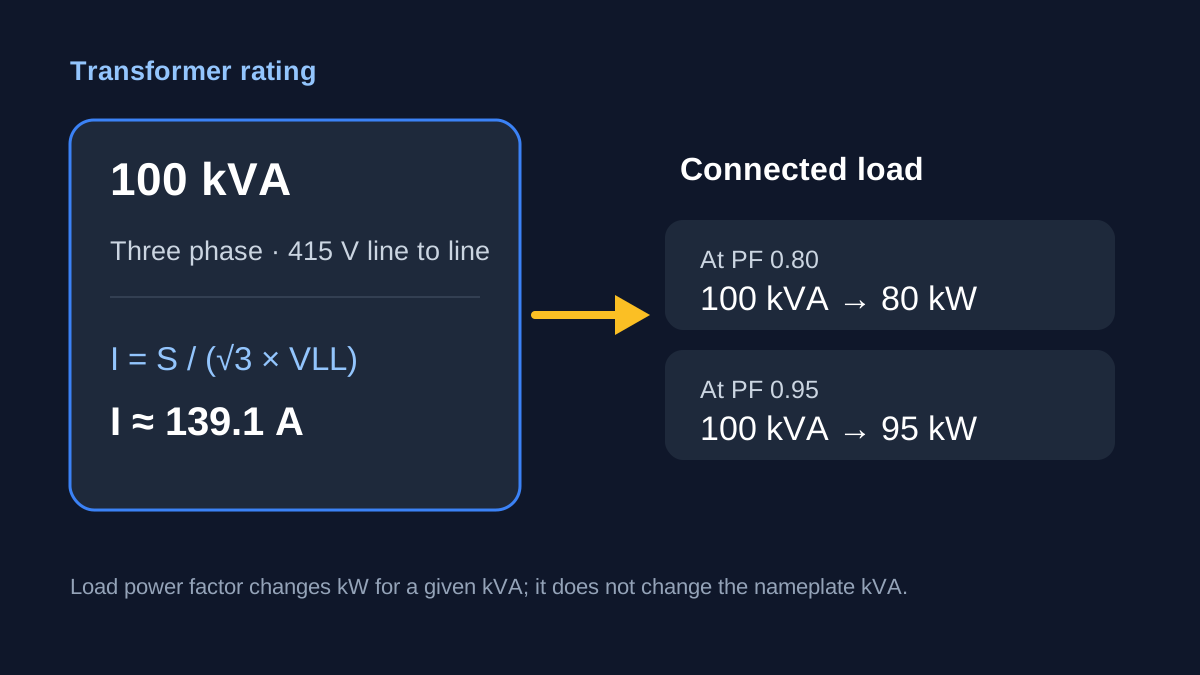
IL = (kVA × 1000) / (√3 × VLL).
Suppose a three-phase transformer has a 100 kVA nameplate and a nominal secondary voltage of 415 V line-to-line:
IL = 100,000 / (√3 × 415) = 139.12 A.
That is a nominal balanced line-current calculation from the stated kVA and voltage. It is not the measured current at this moment and does not include transformer inrush or fault current. A change in stated voltage changes the current answer: the same 100 kVA at 400 V gives about 144.34 A.
Why power factor changes kW but not kVA-derived current
At a particular operating point, P = S × PF, where P is active power and PF is power factor. If a load uses 100 kVA at PF = 0.80, its active power is 80 kW. If it uses the same 100 kVA at PF = 0.95, active power is 95 kW. With the same voltage and apparent power, the corresponding current remains the same in this simplified steady-state calculation.
This is why a transformer rating in kVA is useful: it tells you about voltage-and-current duty without assuming one power factor for every future load. Core loss is closely tied to applied voltage and frequency, while winding losses rise with current. The connected load’s PF influences how much active power accompanies that current, but it does not turn a nameplate kVA rating into a fixed kW rating.
That explanation is a model, not a claim that all transformer behaviour is independent of load waveform or operating conditions. Harmonics, ambient temperature, cooling, duty and manufacturer limits matter in real equipment.
Do not confuse rating with measured loading
A 100 kVA nameplate might serve a load drawing 40 kVA, 80 kVA or some changing value across the day. To estimate operating loading, use measured voltage and current from the same transformer side and operating instant. For a balanced three-phase case:
Operating kVA = √3 × VLL × IL / 1000.
At 415 V and 100 A, that is about 71.88 kVA. Compared with a 100 kVA nameplate, the ratio is about 71.88%. The transformer loading percentage guide covers that arithmetic and its limits. It does not automatically decide how much additional load can be connected.
Read the rest of the nameplate
Before using any formula, check which side the voltage refers to, whether the equipment is single or three phase, its rated frequency and the applicable cooling or duty information. Manufacturer documents may specify different ratings for different conditions. A primary current calculated from nominal input voltage should not be presented as a direct measurement of primary operating current.
A motor nameplate can make this more confusing because its prominent kW number often describes mechanical shaft output, whereas the transformer kVA is an electrical apparent-power rating. Converting motor shaft kW into electrical input requires efficiency; converting electrical input kW into kVA requires power factor. Neither conversion is achieved by simply replacing “kW” with “kVA.” See the kW, kVA and kVAr comparison for the three power quantities.
When documenting a transformer calculation, write the nameplate kVA, phase arrangement, voltage side, entered voltage and result together. Then calculate the corresponding current and verify the equipment and installation constraints separately.
Sources and limits
Preliminary engineering aid only. A nameplate kVA rating and this current conversion do not establish allowable loading in every ambient, cooling or duty condition. Confirm actual equipment ratings and limits with qualified professional review.
Verify applicable laws, standards, manufacturer data and project conditions with a qualified electrical professional before construction, procurement or regulatory submission.
CONTINUE READING
Related articles
Power and current
kW, kVA and kVAr: what each number tells you
These three quantities are related, but they answer different questions about an AC load and its effect on the supply.
Power and current
Transformer full-load current on the primary and secondary sides
A transformer keeps approximately the same apparent-power rating across both sides, but current changes as voltage changes.
Measurements and equipment
Transformer Loading Percentage: From Measured Amps to kVA
Full-load current starts with the nameplate. Operating loading starts with a measurement. Keep these two questions separate.