
Measurements and equipment
Transformer Loading Percentage: From Measured Amps to kVA
Full-load current starts with the nameplate. Operating loading starts with a measurement. Keep these two questions separate.
Estimate transformer loading →Published 3 October 2026
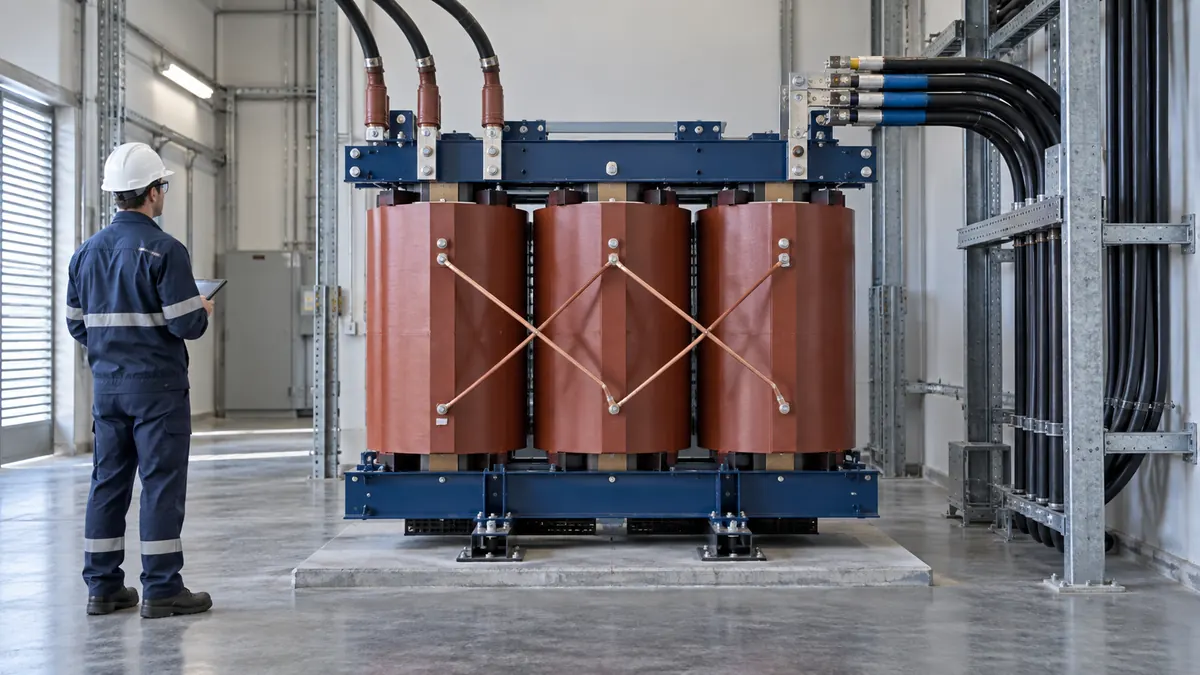
A nameplate and a measurement answer different questions
The full-load-current calculation asks what current corresponds to the transformer’s rated kVA. A loading calculation asks how the apparent power at an operating point compares with that rating. A transformer may operate below, near or above its nameplate kVA; the percentage alone does not establish whether the condition is acceptable.
Open operating loading mode. Enter measurements from one side only. Combining primary voltage with secondary current produces a number, but not the apparent power on either side.
A 100 kVA transformer carrying 100 A
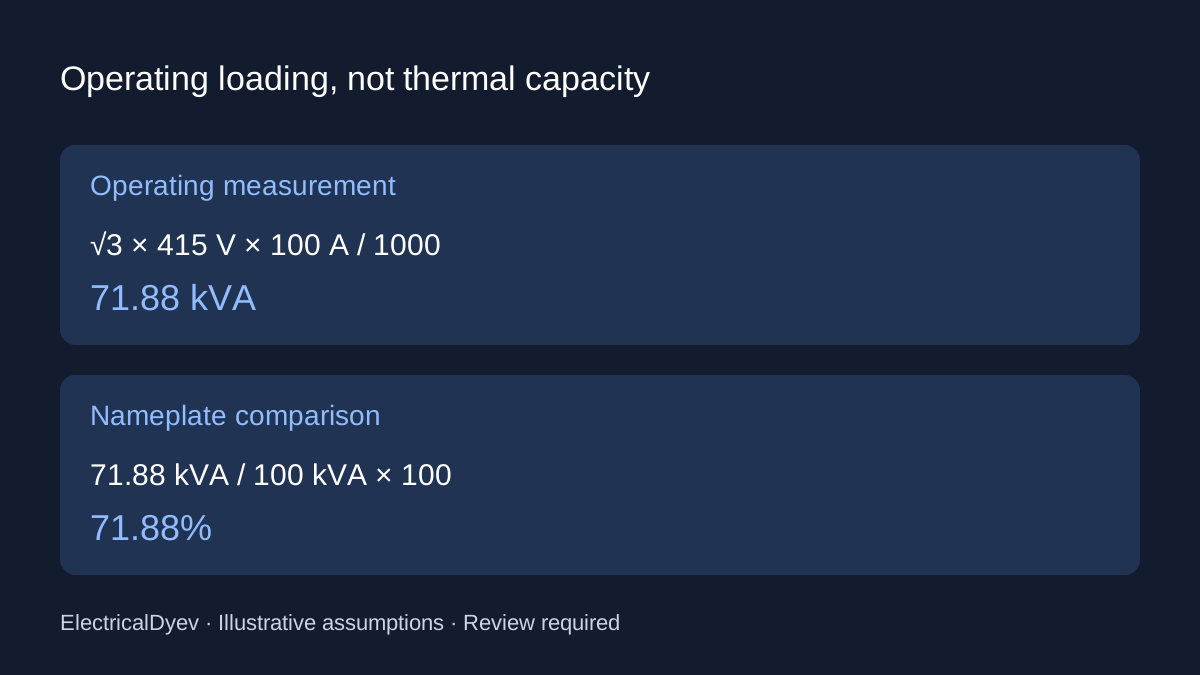
Assume balanced sinusoidal three-phase operation at 415 V line-to-line. With 100 A line current:
S = √3 × VLL × IL / 1000
S = √3 × 415 × 100 / 1000 = 71.88 kVA
Loading = operating kVA / nameplate kVA × 100
Loading = 71.88 / 100 × 100 = 71.88%
This expresses an apparent-power ratio for the stated operating condition. It is not a measurement of winding temperature, insulation ageing or allowable additional load.
Why a current ratio can give a different answer
At nominal voltage, operating current divided by rated current gives the same ratio for the simple model. If voltage changes, the apparent-power estimate changes too. At 400 V and 100 A, the apparent power is 69.28 kVA, not 71.88 kVA.
Use actual operating voltage when assessing a measurement snapshot. Keep nominal voltage when documenting a clearly labelled nominal scenario. Do not mix the two silently, and retain the measurement time so another person can reproduce the comparison.
Single phase does not use √3
A 25 kVA single-phase transformer supplying 230 V at 50 A has:
S = 230 × 50 / 1000 = 11.50 kVA
Loading = 11.50 / 25 × 100 = 46%
The 230 V is the voltage across the supply terminals being assessed. No assumed power factor is required for these apparent-power calculations. To estimate kW, you would additionally need a suitable PF or a direct active-power measurement.
Conditions the percentage cannot resolve
Ambient temperature, cooling condition, load duration, harmonics and the transformer’s construction affect its operating limits. A short peak and a continuous duty are different engineering questions. Unequal phase currents also mean that a single balanced-current input may conceal a heavily loaded winding.
Do not average strongly unequal phase readings simply to obtain a neat percentage. Record the separate measurements and use a suitable power-quality assessment. For distorted waveforms, the simplified relationship is not a replacement for an instrument and method suited to the required apparent-power definition.
If the estimate exceeds 100%, the tool flags that it is above the entered nameplate kVA. It does not supply an allowable duration or recommend continued operation. If it is below 100%, the result still does not certify thermal suitability.
Keep a useful record
Record the transformer identification, nameplate kVA, measurement side, phase arrangement, voltages, currents, time and load condition. Include any known cooling or harmonic concerns. This makes repeat measurements useful instead of turning isolated readings into an apparent trend.
Compare an operating snapshot, or return to full-load current when only the nameplate information is known.
Sources and limits
Preliminary engineering aid only. Loading percentage is not a permissible overload or safe operating limit. Manufacturer loading guidance and a qualified engineering assessment remain necessary.
Verify applicable laws, standards, manufacturer data and project conditions with a qualified electrical professional before construction, procurement or regulatory submission.
CONTINUE READING
Related articles
Power and current
Transformer full-load current on the primary and secondary sides
A transformer keeps approximately the same apparent-power rating across both sides, but current changes as voltage changes.
Power and current
kVA to Amps: Single-Phase and Three-Phase Worked Examples
The same kVA rating produces different current at different voltages. Start with the phase arrangement and the voltage reference.
Power and current
Why current rises when power factor falls
Power factor changes current without changing the active kW requirement. A short table makes the effect easy to see.