
Power and current
kW, kVA and kVAr: what each number tells you
These three quantities are related, but they answer different questions about an AC load and its effect on the supply.
Open the power-factor correction calculator →Published 26 September 2026

kW: active power
Kilowatts describe active power: the rate at which electrical energy is converted into useful work, heat, light and losses. Energy meters integrate active power over time to produce kilowatt-hours.
For a balanced three-phase load, active power is P = √3 × VLL × I × PF.
kVA: apparent power
Kilovolt-amperes describe the product of RMS voltage and current without multiplying by power factor. For balanced three phase:
S = √3 × VLL × I
Transformers and other supply equipment are often concerned with apparent power because voltage and current both contribute to loading. A 100 kVA transformer does not become a 100 kW source for every load; the active power depends on the load power factor and equipment limits.
kVAr: reactive power
Kilovolt-amperes reactive describe the oscillating energy exchange associated with reactive elements in the sinusoidal model. It contributes to current and apparent power even though it is not active work at the load.
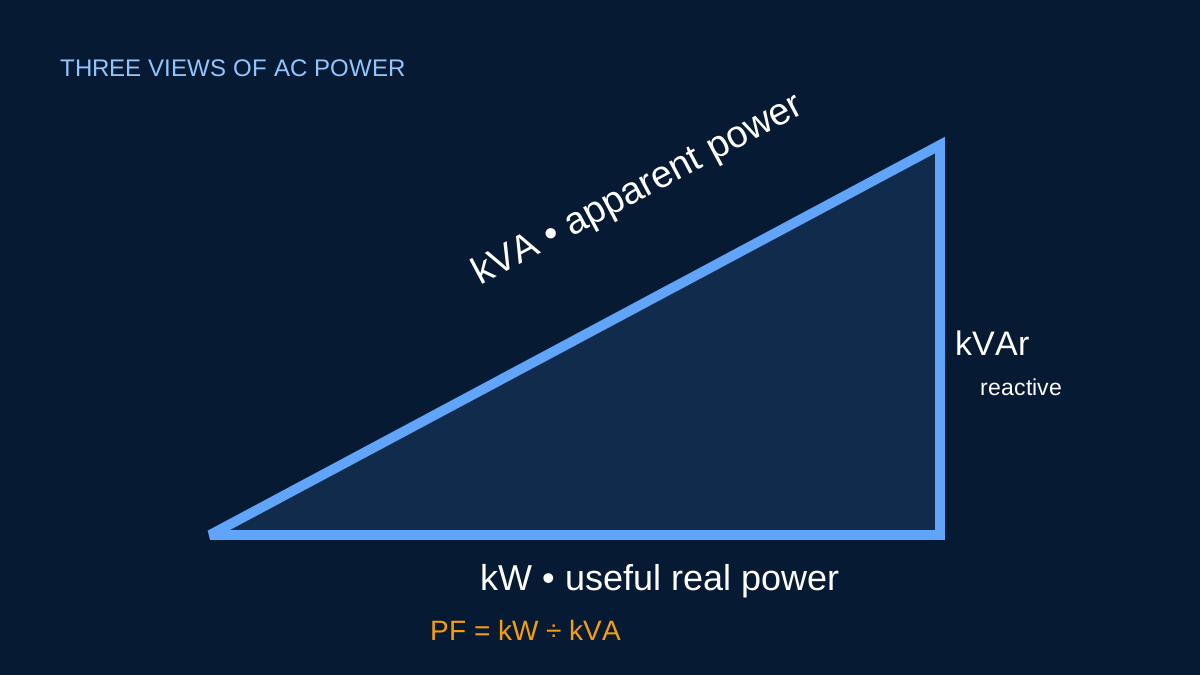
The power triangle relationship is:
S² = P² + Q²
and power factor is PF = P / S.
A numerical example
A 100 kW load at power factor 0.80 has:
S = 100 / 0.80 = 125 kVA
Q = √(125² − 100²) = 75 kVAr
If correction improves power factor to 0.95 while active power stays 100 kW:
S = 100 / 0.95 = 105.26 kVA
Reactive power falls to about 32.87 kVAr. The difference is approximately 42.13 kVAr, which is the preliminary correction requirement.
Why the distinction matters
Two loads can consume the same kW while drawing different current. Cables and switchgear carry the current associated with kVA, not only the active component. A low power factor can therefore use more distribution capacity and increase conductor losses.
Do not treat kVAr as wasted energy in the same way as kWh. It describes a different component of AC power flow. The practical objective is to understand its effect on the network and manage it appropriately.
Beyond the simple triangle
The triangle is clearest for sinusoidal voltage and current. Harmonics introduce distortion power and require more complete power-quality definitions and measurement. Use the simple relationships for transparent preliminary calculations, and use suitable instrumentation when waveform quality matters.
Read the three quantities as a set
Kilowatts describe active power: the rate at which electrical energy is converted into useful output and losses. Kilovolt-amperes describe apparent power: the product of RMS voltage and RMS current under the applicable single- or three-phase relationship. Kilovolt-amperes reactive describe the quadrature component associated with energy moving back and forth in reactive elements.
For sinusoidal conditions, the three form a right triangle:
S² = P² + Q²
where S is kVA, P is kW and Q is kVAr. Power factor is P ÷ S. The units carry different meanings even though all three expressions are derived from voltage and current.
A 100 kVA example
Suppose a balanced load operates at 100 kVA and PF 0.80. Its active power is:
P = 100 × 0.80 = 80 kW
Reactive power is:
Q = √(100² − 80²) = 60 kVAr
At 415 V, the line current is based on apparent power: 100,000 ÷ (√3 × 415) = 139.12 A. Multiplying that current by voltage and √3 without applying power factor returns kVA, not kW.
Why equipment ratings often use kVA
Transformers, generators and conductors must accommodate voltage and current even when power factor changes. A kVA rating therefore describes a useful electrical loading boundary without assuming how much of that apparent power becomes active power in the connected load.
That does not mean kW is unimportant. Prime movers, energy use, heat and process output often depend strongly on active power. A design conversation should say which limit is being checked rather than treating kW and kVA as interchangeable labels.
What changes after power-factor correction
If active power and voltage stay constant while power factor improves, kVA and current fall. The load is still doing the same idealised active work; the reactive component has reduced. The released current capacity may be operationally useful, but actual loss or cost changes depend on the installation and tariff and should be measured rather than promised from the triangle alone.
When harmonics are material, displacement power factor and total power factor can differ. A basic calculator using one PF number cannot characterise the waveform. Use a suitable power-quality instrument and retain the measurement conditions with the result.
Sources and limits
Preliminary engineering aid only. The power triangle is a steady sinusoidal model and needs additional treatment for distorted waveforms and harmonic power.
Verify applicable laws, standards, manufacturer data and project conditions with a qualified electrical professional before construction, procurement or regulatory submission.
CONTINUE READING
Related articles
Power and current
Why current rises when power factor falls
Power factor changes current without changing the active kW requirement. A short table makes the effect easy to see.
Power and current
How much kVAr is needed to improve power factor?
The kVAr formula is straightforward. Choosing equipment safely still requires harmonic, resonance and switching studies.
Power and current
Transformer full-load current on the primary and secondary sides
A transformer keeps approximately the same apparent-power rating across both sides, but current changes as voltage changes.