
Power and current
Where neutral current comes from in a three-phase system
Equal phase currents cancel in the neutral only under specific waveform and phase conditions. Here is what the familiar vector calculation includes.
Open the neutral current calculator →Published 26 September 2026

Why the three currents do not simply add
If three numbers on a clamp meter read 100 A, 80 A and 60 A, adding them gives 240 A. That is not the neutral current. In a three-phase system the phase currents are displaced in time, so they must be added as vectors.
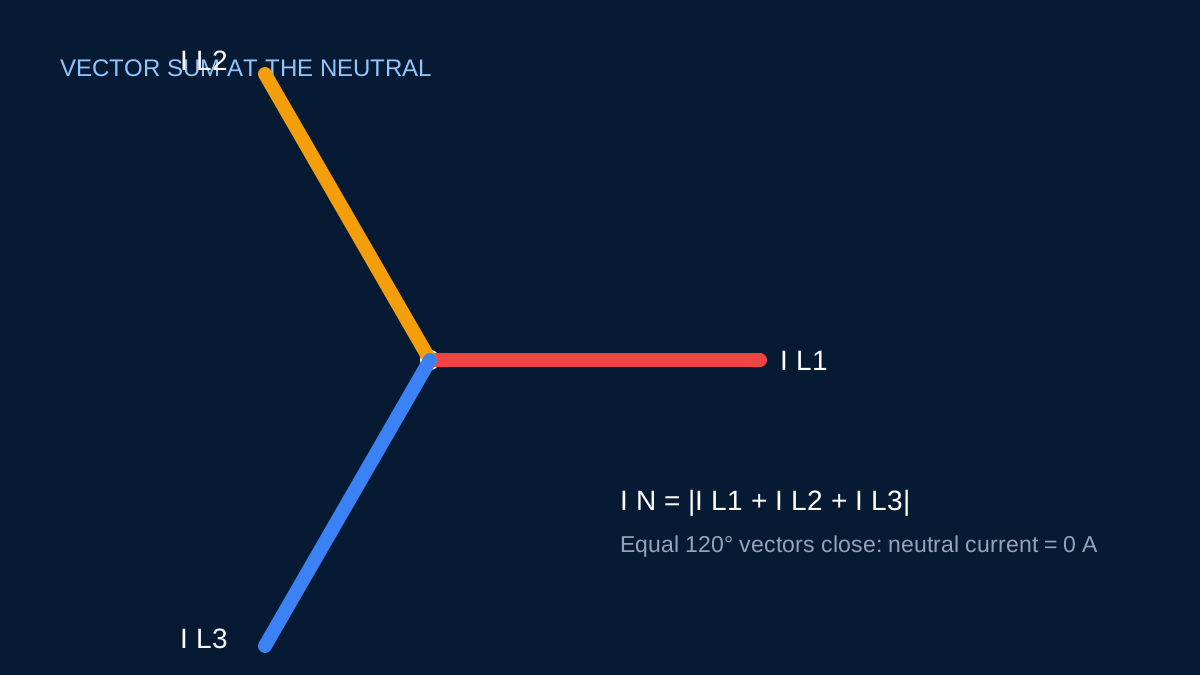
For three fundamental currents separated by 120°, the magnitude of the residual is:
IN = √(IL1² + IL2² + IL3² − IL1IL2 − IL2IL3 − IL3IL1)
With 100 A, 80 A and 60 A:
IN = √(100² + 80² + 60² − 100×80 − 80×60 − 60×100)
IN = √1,200 = 34.64 A
That value describes the residual of the fundamental components under the assumed phase relationship.
The balanced case
Put 10 A into all three phases and the expression under the square root becomes zero. The three equal vectors cancel. This is why a perfectly balanced, sinusoidal three-phase load can have no fundamental neutral current.
Real load schedules seldom remain perfectly balanced. Single-phase circuits switch on and off, lighting groups change, and operating conditions move throughout the day. The calculator can show the effect of different fundamental phase-current magnitudes, but it does not predict how loads will vary over time.
Harmonics change the story
Many electronic loads draw non-sinusoidal current. Certain harmonic components, particularly triplen harmonics, can be in phase with each other in the neutral rather than cancelling. A neutral conductor can therefore carry more current than the simple fundamental calculation suggests.
That is not a small footnote. Offices, data equipment, LED drivers, electronic power supplies and other nonlinear loads can require waveform measurement and a harmonic assessment. Entering total RMS clamp readings into a formula derived for fundamental 120° vectors may not describe the actual addition correctly.
A sensible workflow
Use the calculator for an initial fundamental-current check when phase-current magnitudes are known. Keep the operating time and measurement point consistent. If the load is nonlinear, the phase readings are unstable, or neutral heating matters, measure the neutral directly with suitable equipment and review harmonic content.
The displayed phase spread is descriptive only. It helps compare the three entered magnitudes, but it is not a universal permissible-unbalance limit.
What to record
- Whether the readings are fundamental or total RMS.
- The load condition and time of measurement.
- The current on every phase and the neutral.
- Any known nonlinear equipment or harmonic filters.
- Whether the system has shared neutrals or unusual transformer connections.
Those notes make the calculation auditable and prevent a clean-looking 0 A result from being mistaken for a guarantee that no neutral current will flow.
A useful way to sanity-check the answer
The calculated fundamental neutral current should never be greater than the arithmetic sum of the three phase currents. It can, however, be greater than the smallest phase current. Consider 40 A, 40 A and 0 A. The two live phase-current vectors are 120° apart; their vector sum has a magnitude of 40 A. It would be wrong to assume the neutral must carry only the 0 A “difference” between the two equal readings.
Another useful check is symmetry. Swapping the L1, L2 and L3 magnitudes in this particular formula does not change the result because the formula assumes the same 120° separation between each pair. If a phase-angle measurement shows something materially different, the magnitude-only calculator is no longer an adequate model.
For a balanced 10/10/10 A case, the result is 0 A. For 10/0/0 A, it is 10 A. Those two boundary cases are simple enough to calculate mentally and are useful for confirming that data has been entered in amperes rather than milliamperes or a scaled instrument value.
What to measure on a real board
If the neutral matters to a design decision, measure all three phase currents and the neutral during the same operating period. Readings taken on different days or with different equipment states do not form one valid vector snapshot. Note which large single-phase and nonlinear loads were running, and whether automatic load sequences were active.
A true-RMS clamp meter can report current magnitude, but it does not by itself separate fundamental current from harmonics. A power-quality instrument is more appropriate when electronic lighting, computer supplies, variable-speed drives or other nonlinear loads are significant. Neutral heating also depends on conductor size, grouping, ambient conditions, terminations and waveform content, not simply the one number returned here.
Using the result in a load schedule
The calculated value is best stored as a clearly labelled scenario: for example, “fundamental neutral estimate at recorded phase currents”. Keep the three inputs beside it. If a load schedule contains balanced three-phase circuits and phase-assigned single-phase circuits, build the phase totals first, then calculate the fundamental residual. Do not add the line-current magnitude of every three-phase circuit into the neutral column.
For future changes, retain headroom and the original measurements rather than copying only the final neutral value. A later reviewer should be able to see whether a change came from phase balance, harmonic content or simply a different operating snapshot.
Sources and limits
Preliminary engineering aid only. This calculation covers fundamental sinusoidal currents only; a measured or harmonic study is needed for nonlinear loads and distorted waveforms.
Verify applicable laws, standards, manufacturer data and project conditions with a qualified electrical professional before construction, procurement or regulatory submission.
CONTINUE READING
Related articles
Power and current
Balanced three-phase current: the preliminary calculation
A transparent explanation of the familiar √3 relationship, the voltage that belongs in it and the conditions under which it is useful.
Power and current
Line current and phase current are not always the same
In star, line current matches winding current. In delta, the balanced line current is √3 times the phase-branch current.
Protection and project workflow
Building a load schedule that shows demand and phase balance
A load schedule should explain where its totals came from, not just produce one large kW number at the bottom.