Power and current
Line current and phase current are not always the same
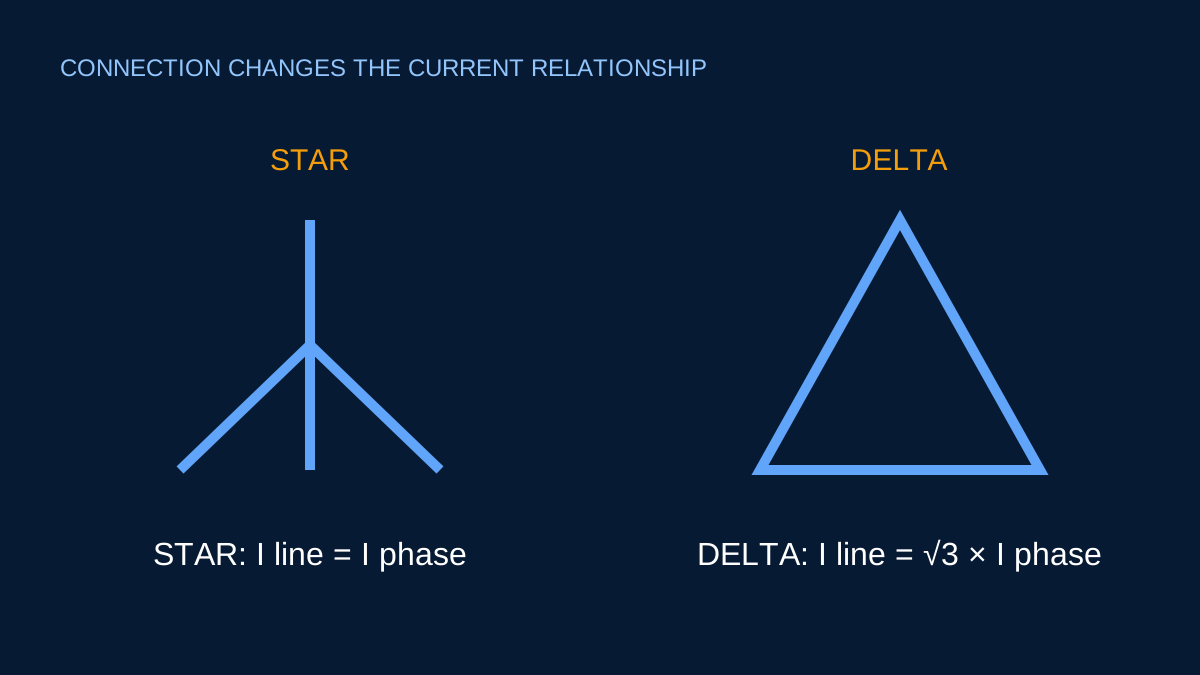
In star, line current matches winding current. In delta, the balanced line current is √3 times the phase-branch current.
Open the three-phase current calculator →Published 26 September 2026
Two currents, two locations
Line current flows in the supply conductors. Phase current flows through one phase of the connected load, such as one motor winding or one branch of a three-phase impedance. Whether they are equal depends on the connection.
Using the word “current” without stating the location is an invitation to mix them up.
Balanced star connection
In star, each load phase connects from a line to the common star point. For a balanced load:
IL = Iph
Each phase sees phase-to-neutral voltage, while line-to-line voltage is √3 times larger:
VLL = √3 × Vph
If a star-connected winding carries 20 A, the corresponding line conductor carries 20 A under the balanced assumption.
Balanced delta connection
In delta, each phase branch connects between two lines. Each branch therefore sees line-to-line voltage:
Vph = VLL
The line current is the vector difference of two branch currents. For a balanced load:
IL = √3 × Iph
If each delta branch carries 20 A, line current is approximately 34.64 A.
Why motor labels can be confusing
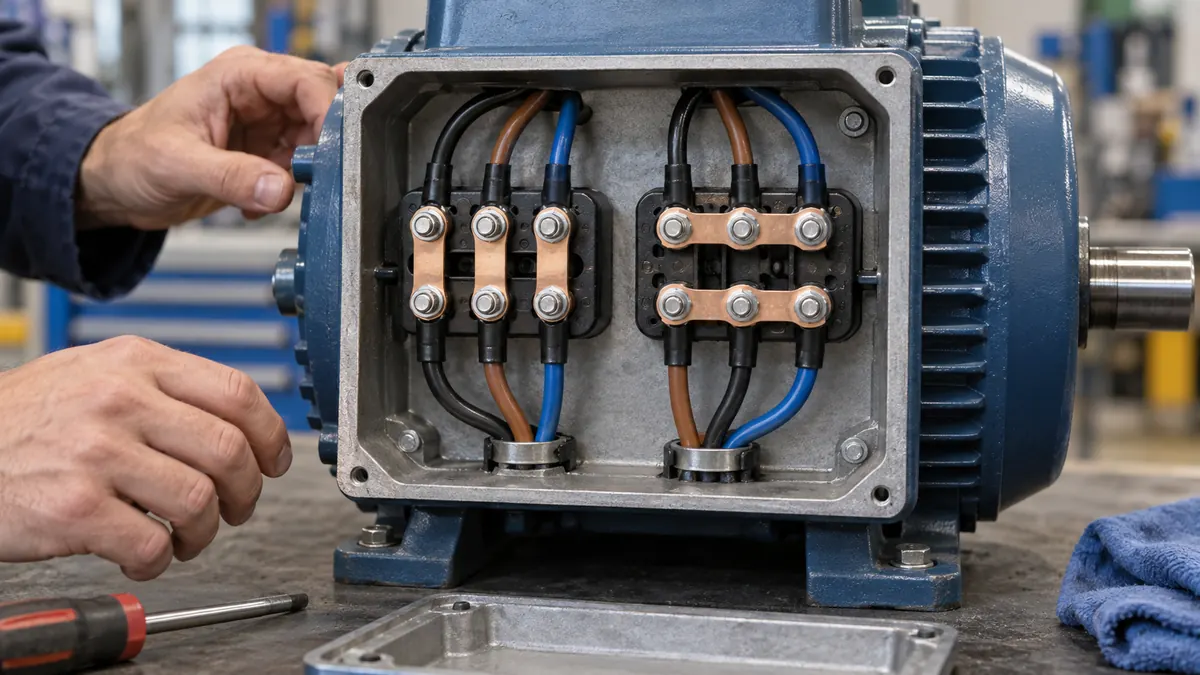
A dual-voltage motor nameplate may show different connection diagrams and current ratings. The links in the terminal box determine the voltage applied to each winding. A current calculated from total three-phase power is line current; it should not automatically be compared with an assumed winding current without checking the connection and nameplate.
Star-delta starting introduces another operating state. Starting connections, transition and running connections have different current relationships. A steady-state power calculator does not reproduce the transient behavior.
A useful identification habit
Label measurements and calculations explicitly:
IL1,IL2,IL3for line currents;Iphfor current in one load phase;VLLfor line-to-line voltage;Vphfor voltage across one phase.
Then draw or confirm the connection. This small discipline prevents a √3 error from passing through load schedules, cable checks and protection calculations.
When the balanced relationship is insufficient
Unequal impedances, open phases, supply unbalance and harmonic currents require more detailed analysis. Measure all line currents and relevant voltages, and use manufacturer information for equipment connections. The star/delta relationships are a foundation, not a substitute for inspecting the actual circuit.
Follow the conductor, not just the label
Line current is the current in an external line conductor feeding the three-phase load. Phase current is the current through one phase element or winding inside the load connection. Those can be the same number, but only for particular connections.
In star, each line conductor is in series with one phase element, so IL = Iphase. In delta, each line conductor connects to a junction between two phase elements. Their vector difference produces IL = √3 × Iphase for a balanced load. This is why a 30 A line current in a balanced delta winding corresponds to about 30 ÷ 1.732 = 17.32 A in each winding.
Voltage relationships move in the opposite place
Star and delta trade where the √3 relationship appears. In star, phase voltage is line voltage divided by √3, while line and phase currents are equal. In delta, phase voltage equals line voltage, while line current is √3 times phase current.
At 415 V line-to-line, an ideal star-connected winding sees about 240 V. A delta-connected winding sees 415 V. This is why a motor’s voltage and connection marking must be read before changing links or interpreting current. The calculator does not decide a motor connection from its power rating.
Where measurements can mislead
A clamp around a supply conductor measures line current. Accessing a winding current may require internal conductors or drive data and should not be attempted without appropriate procedures. If a variable-speed drive sits between the supply and motor, its input line current and motor-side phase current are different quantities with different waveforms.
Record the measurement location: upstream of a drive, downstream of a drive, in a line conductor, or in an accessible winding lead. Also record whether the equipment was starting, accelerating or at steady load. Without that context, two valid readings may appear to contradict each other.
Use the balanced formulas as a model check
For a balanced 15 kW load at 415 V and PF 0.85, the estimated line current is about 24.55 A. That is the external conductor current. Converting it to a winding current requires the actual star or delta connection.
If the three measured line currents differ, avoid averaging them merely to make the balanced formula fit. Phase imbalance can affect heating and equipment performance. Preserve the individual readings and move to a phase-by-phase assessment.
Sources and limits
Preliminary engineering aid only. Connection links and equipment terminals must be verified from manufacturer information by a qualified person before energisation.
Verify applicable laws, standards, manufacturer data and project conditions with a qualified electrical professional before construction, procurement or regulatory submission.
CONTINUE READING
Related articles
Power and current
Why √3 appears in three-phase power calculations
The √3 factor is geometry, not a memorised correction. It connects phase quantities with line quantities in a balanced system.
Power and current
Line-to-line and line-to-neutral voltage, without the usual confusion
A three-phase voltage needs a reference: between two lines, or from one line to neutral. The formulas cannot decide that for you.
Measurements and equipment
Reading a motor nameplate before calculating current
A nameplate already contains many of the assumptions a calculator would otherwise have to guess. Read them as one matched rating set.