
Measurements and equipment
What Is a Normal Neutral Current in a Three-Phase System?
A balanced fundamental can cancel in the neutral while harmonic current remains. Interpret the reading before comparing it with a simple calculation.
Estimate fundamental neutral current →Published 10 October 2026

There is no single number called “normal”
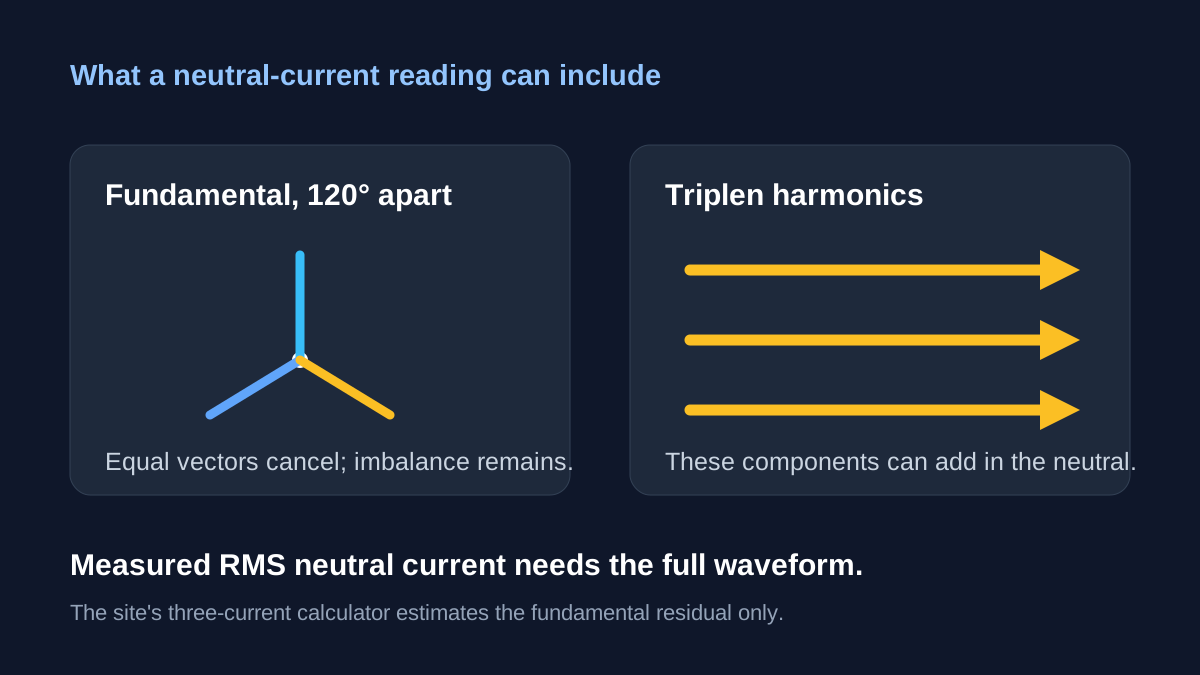
In a three-phase, four-wire system, the neutral carries the vector sum of currents returning from phase-to-neutral loads. Under a special ideal condition—equal sinusoidal fundamental currents separated by 120°—those components cancel. That is the origin of the familiar statement that neutral current is zero in a balanced three-phase system.
Real circuits may have unequal phase loads, changing operating conditions and nonlinear equipment. A nonzero reading by itself does not tell you whether something is wrong. Equally, a low reading at one moment does not prove the neutral conductor is adequately sized or that future loading will behave the same way. “Normal” has to be interpreted in the context of the particular circuit, waveform, instrument and operating condition.
Try the neutral-current calculator if you have three fundamental phase-current magnitudes from the same operating condition. It estimates only the 120° vector residual; it does not reconstruct a harmonic waveform.
What the fundamental calculation actually says
For three sinusoidal phase currents 120° apart, the magnitude of their neutral residual can be written:
IN = √(IL1² + IL2² + IL3² − IL1×IL2 − IL2×IL3 − IL3×IL1).
If IL1 = IL2 = IL3 = 20 A, substitution gives IN = 0 A for the fundamental component. If the currents are 30 A, 20 A and 20 A, the equation gives 10 A. The extra 10 A on one phase leaves a 10 A fundamental residual under the stated phase-angle assumption.
For 50 A, 40 A and 30 A, the result is √300 = 17.32 A. Adding the three magnitudes arithmetically would produce 120 A; that is not the vector residual. Subtracting the lowest phase from the highest gives 20 A; that shortcut is not the general three-phase result either.
The vector explanation shows why direction matters. If phase angles are not the assumed 120°, magnitude-only inputs do not describe the full situation.
Why a clamp meter may show more
Many electronic loads draw distorted current. Certain harmonic orders—third, ninth, fifteenth and other “triplen” harmonics—can add in the neutral instead of cancelling as the balanced fundamental does. A true-RMS clamp reading around the neutral can therefore be higher than the fundamental-only estimate, even when the three phase-current magnitudes look similar.
For example, three equal 20 A fundamental phase components imply a calculated fundamental neutral of zero. That statement says nothing about triplen-harmonic neutral current. Reporting “0 A neutral current” as a prediction of the full RMS neutral waveform would hide information the model never had.
If the calculated and measured values differ, first check that the phase readings and neutral reading were taken under the same operating conditions and that the instrument captures the needed waveform. Then consider harmonics, phase angles and measurement technique. A power-quality study may be needed to explain a large or variable discrepancy. See how neutral current is measured for the distinction between measuring one conductor and measuring a group of conductors.
Interpreting a reading for a real installation
Record the time, phase currents, neutral current, dominant loads, instrument mode and whether substantial nonlinear loads were operating. Repeat measurements across representative conditions rather than using one quiet period as the whole story. A load schedule can help explain fundamental imbalance, but its demand assumptions are not a substitute for measured harmonic content.
Do not adopt a universal percentage such as “neutral current must be below X% of phase current” from this article. The applicable conductor capacity, installation method, protective arrangement and local requirements need their own assessment. The load-schedule guide helps organise phase allocations; it does not certify the neutral.
The practical answer is that a normal neutral-current value is installation-specific. Use the calculator to understand the fundamental residual, use appropriate measurement to see what is actually flowing, and have a qualified professional review the difference and the conductor duty.
Sources and limits
Preliminary engineering aid only. A calculated fundamental residual cannot establish conductor adequacy or explain an entire RMS waveform. Measurement and harmonic analysis around energized equipment require competent personnel and suitable instruments.
Verify applicable laws, standards, manufacturer data and project conditions with a qualified electrical professional before construction, procurement or regulatory submission.
CONTINUE READING
Related articles
Power and current
Where neutral current comes from in a three-phase system
Equal phase currents cancel in the neutral only under specific waveform and phase conditions. Here is what the familiar vector calculation includes.
Measurements and equipment
Neutral Current Measurement: Why the Reading Can Differ from the Calculation
Three phase-current magnitudes are not the whole waveform. A neutral reading can expose assumptions that a simple calculation cannot represent.
Protection and project workflow
Building a load schedule that shows demand and phase balance
A load schedule should explain where its totals came from, not just produce one large kW number at the bottom.