
Measurements and equipment
Neutral Current Measurement: Why the Reading Can Differ from the Calculation
Three phase-current magnitudes are not the whole waveform. A neutral reading can expose assumptions that a simple calculation cannot represent.
Explore the fundamental neutral estimate →Published 3 October 2026

First check what the calculated number represents
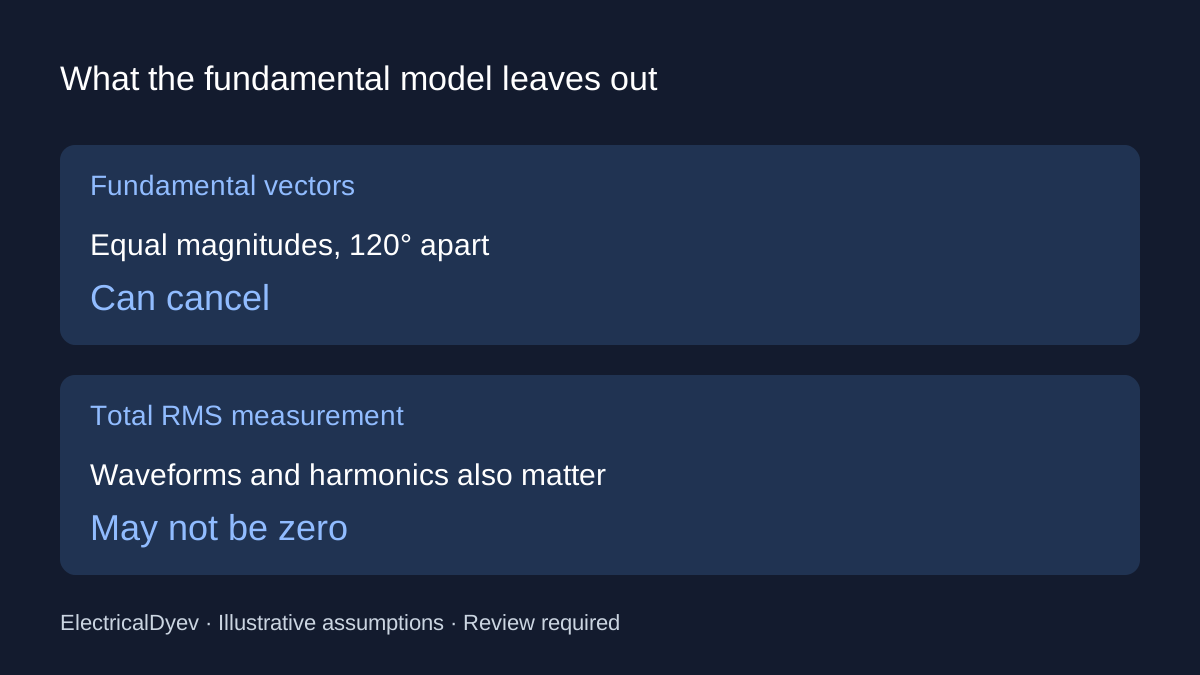
The neutral-current calculator adds three fundamental current vectors separated by 120 degrees. A clamp meter may report total RMS current, including waveform components that the model does not contain. Comparing the two as if they were identical quantities can make a correct calculation appear wrong.
Before investigating a discrepancy, label both results. Was the calculated input a fundamental RMS measurement or a total RMS reading? Was the neutral reading taken during the same load condition? Were the phase-current angles actually consistent with the model?
A reference case you can calculate by hand
For fundamental phase currents of 100 A, 80 A and 60 A separated by 120 degrees:
IN = √(100² + 80² + 60² − 100×80 − 80×60 − 60×100)
IN = √1200 = 34.64 A
This is a model result, not a promise about an installation. If the three readings include significant harmonic current, entering their total RMS magnitudes does not somehow provide the calculator with the missing waveform information.
Equal magnitudes are not sufficient information
The model returns zero for three equal fundamental currents separated by 120 degrees. If the load power factors differ between phases, the current-angle separations need not match that assumption. A magnitude-only input cannot describe those angles.
There is another distinction: equal total RMS readings do not prove that the waveforms are identical shifted copies. Different electronic loads can produce different waveform shapes while giving similar displayed amperes. A small fundamental residual can coexist with meaningful neutral current from other components.
Harmonics need their own assessment
Certain harmonic components can reinforce one another in the neutral rather than cancel. This is especially relevant to nonlinear loads. The correct next question is about waveform composition and timing, not which arbitrary multiplier to apply to the fundamental answer.
Different-frequency components are not generally combined by simply adding their RMS magnitudes. Do not add a guessed third-harmonic percentage to the calculator result and call it a neutral-conductor design. Suitable measurement and engineering interpretation are needed when waveform distortion matters.
A measurement record is more useful than one number
Ask the qualified person conducting the assessment to retain the instrument model, measurement definition, operating time, phase and neutral readings, and the load state. Note whether lighting, electronic power supplies or variable-speed equipment was operating. A sequence of readings taken as equipment switches can describe several different systems, not one simultaneous snapshot.
Instrument range, frequency response and measurement location also matter. A reading should be interpreted with the instrument’s instructions and the circuit arrangement. This article deliberately does not provide instructions for opening or probing an energised panel.
What the comparison can tell you
A disagreement is a reason to examine assumptions. It is not, by itself, proof of faulty equipment or a dangerous neutral. Conversely, agreement with the simple formula does not verify conductor suitability, terminations or thermal performance.
Use the calculated value as a labelled fundamental scenario. Keep actual measured results separately, with their conditions. If neutral heating, unexpected current or distorted waveforms are part of the concern, the review must go beyond a browser calculator.
Try the fundamental example, then read where neutral current comes from for the underlying vector relationship.
Sources and limits
Preliminary engineering aid only. This article interprets measurement concepts, not live-panel procedures. Electrical measurements require competent personnel, suitable equipment and appropriate safety procedures.
Verify applicable laws, standards, manufacturer data and project conditions with a qualified electrical professional before construction, procurement or regulatory submission.
CONTINUE READING
Related articles
Power and current
Where neutral current comes from in a three-phase system
Equal phase currents cancel in the neutral only under specific waveform and phase conditions. Here is what the familiar vector calculation includes.
Measurements and equipment
A clamp meter shows amps, not kW
The clamp reading is valuable, but it is one input. Voltage, phase arrangement, power factor and timing complete the power estimate.
Protection and project workflow
Building a load schedule that shows demand and phase balance
A load schedule should explain where its totals came from, not just produce one large kW number at the bottom.