
Measurements and equipment
Reading a motor nameplate before calculating current
A nameplate already contains many of the assumptions a calculator would otherwise have to guess. Read them as one matched rating set.
Check a three-phase current estimate →Published 26 September 2026
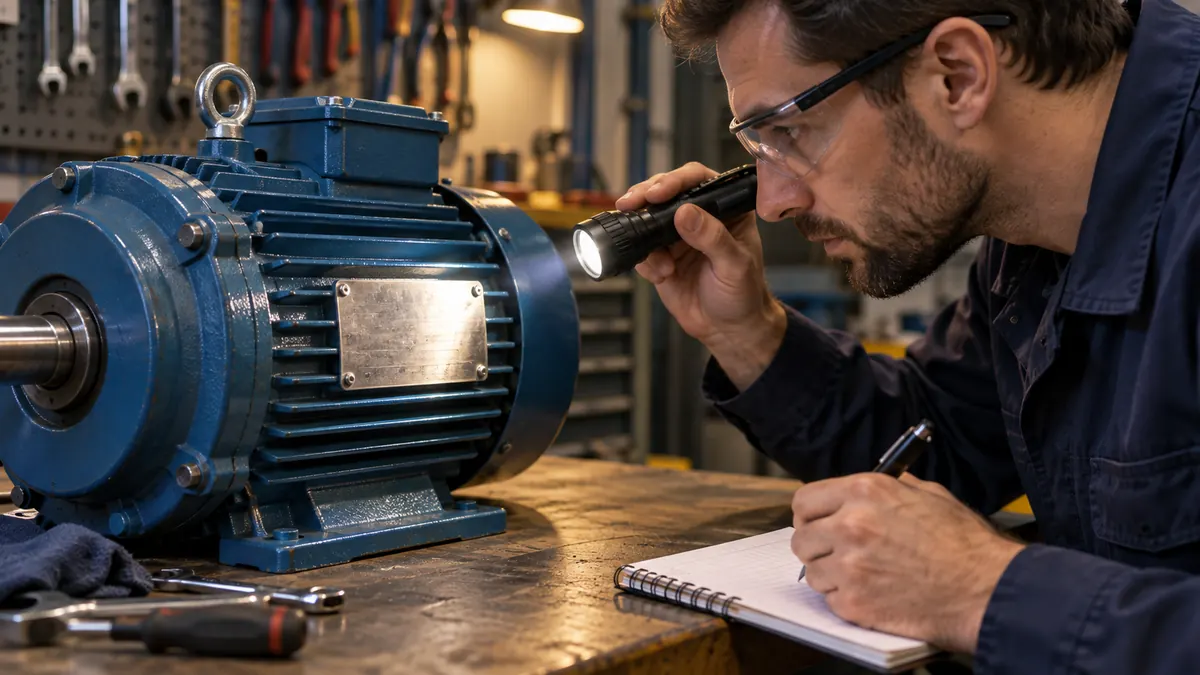
Treat the plate as a set, not a menu
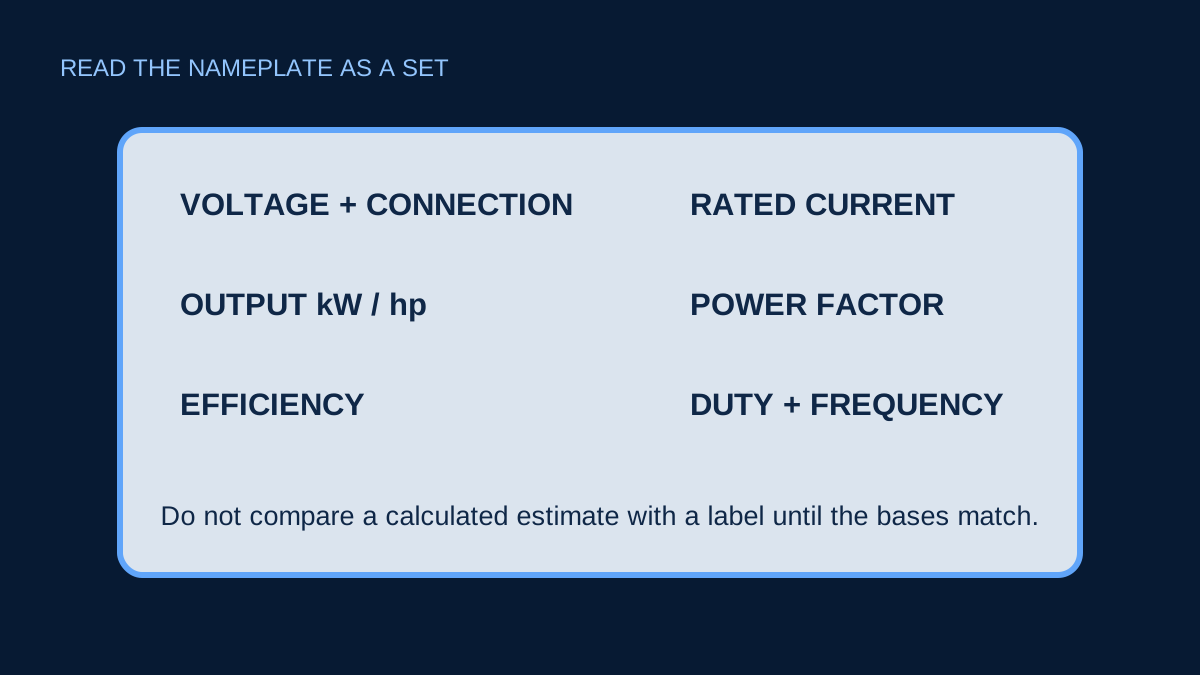
A motor nameplate may show more than one voltage, current or connection. Values on the same row belong together. Choosing voltage from one rating and current from another can create a calculation that describes no valid connection.
Photograph the whole plate, not only the large kW or hp number. Dirt, paint and worn stamping can hide symbols that change the meaning.
Power rating
The kW or hp value on a motor commonly describes rated mechanical output. It is not automatically electrical input. Efficiency connects the two:
Pelectrical = Pshaft / efficiency
If the plate already provides rated current, that value is normally preferable to a generic calculation for the rated condition.
Voltage, phase and connection
Confirm whether the motor is single or three phase, the rated frequency and how terminal links must be arranged for the available voltage. Star and delta connections change the voltage across each winding. Do not alter links from memory; follow the manufacturer’s diagram for the exact motor.
The supply’s nominal line-to-line voltage belongs in a balanced three-phase total-power formula. Winding phase voltage is a different quantity.
Current, efficiency and power factor
Rated current is associated with the stated voltage, frequency, connection and output condition. Efficiency indicates how much electrical input is needed for rated mechanical output. Power factor connects active input power with apparent power and line current.
Together, those values allow a useful cross-check:
I ≈ Pshaft / (√3 × VLL × PF × efficiency)
Small differences from the plate can arise from rounding and the detailed manufacturer basis. A large difference suggests that a unit, convention or rating row has been misunderstood.
Duty, speed and enclosure information
Duty designation tells you whether the rating is intended for continuous or another operating pattern. Rated speed helps identify slip and whether the driven process is operating near expectation. Enclosure, insulation and temperature information matter to installation and service life even though they do not appear in the basic current equation.
Starting is a separate condition
Rated current is not starting current. Direct-on-line starting, star-delta starting and electronic drives create different current and torque behavior. Protection and conductor checks must consider the intended starting method and manufacturer data.
Use a calculator to understand relationships and perform a reasonableness check. Use the complete nameplate and product documentation to understand the actual motor.
Voltage and connection belong together
A nameplate may show two voltages beside star and delta symbols. These are not two independent operating preferences. They describe permitted winding connections for particular line voltages. Confirm the diagram and manufacturer instructions before touching links; a wrong connection can apply the wrong voltage to each winding.
Also check frequency. A motor intended for one voltage/frequency combination may have a different rating at another. Do not copy only the largest voltage number into a current calculator.
Output power is usually shaft power
The kW or hp value on a motor nameplate commonly describes rated mechanical output, not electrical input. The input must be larger because the motor has losses. If efficiency and power factor are available, a reasonableness estimate can be built in stages.
For a 15 kW output motor at 92% efficiency, input active power is about 15 ÷ 0.92 = 16.30 kW. At 415 V balanced three phase and PF 0.86, estimated current is:
I = 16,304 ÷ (√3 × 415 × 0.86) = 26.36 A
Compare that estimate with the nameplate current, but do not overwrite the nameplate with it. Differences may reflect rounding, tolerances, rating definitions or assumptions.
Duty and temperature information change context
Duty marking describes how the motor is intended to operate—continuously, intermittently or in a specified cycle. Insulation class, temperature rise, ambient assumptions and enclosure affect thermal performance. Service factor or equivalent markings, where present, need manufacturer-specific interpretation.
These details are not optional decoration. A motor that can deliver rated output continuously under one set of conditions may require different treatment in a hot, poorly ventilated or high-altitude location.
Record a nameplate before it becomes unreadable
Capture a clear photograph and transcribe the manufacturer, model, serial number, voltage/connection, frequency, current, output, speed, efficiency, PF, duty, enclosure and insulation information. Keep the original units. If a value is unclear, mark it as unknown instead of guessing.
For a driven system, also record the starter or drive model and the mechanical load. This creates a much stronger maintenance and calculation record than a spreadsheet row containing only “motor, 15 kW”.
Sources and limits
Preliminary engineering aid only. Manufacturer documentation and competent inspection govern the actual connection, protection and operating limits; a generic nameplate guide cannot replace them.
Verify applicable laws, standards, manufacturer data and project conditions with a qualified electrical professional before construction, procurement or regulatory submission.
CONTINUE READING
Related articles
Power and current
Horsepower to electrical input: where efficiency belongs
A motor’s shaft output is smaller than its electrical input. Correct conversion begins by identifying which side of the machine the rating describes.
Power and current
Line current and phase current are not always the same
In star, line current matches winding current. In delta, the balanced line current is √3 times the phase-branch current.
Measurements and equipment
A clamp meter shows amps, not kW
The clamp reading is valuable, but it is one input. Voltage, phase arrangement, power factor and timing complete the power estimate.