
Power and current
kVA to Amps: Single-Phase and Three-Phase Worked Examples
The same kVA rating produces different current at different voltages. Start with the phase arrangement and the voltage reference.
Calculate kVA to amps →Published 3 October 2026
Start with apparent power, not active power
A 10 kVA rating describes apparent power. It does not mean 10 kW unless power factor is one. For the current conversion, you need the apparent-power rating, voltage and phase arrangement. You do not divide by power factor again.
Open the converter in kVA mode. Its separate kW result uses the selected PF; the amps result from kVA does not.
Single phase: 10 kVA at 230 V
Use the voltage across the actual load terminals:
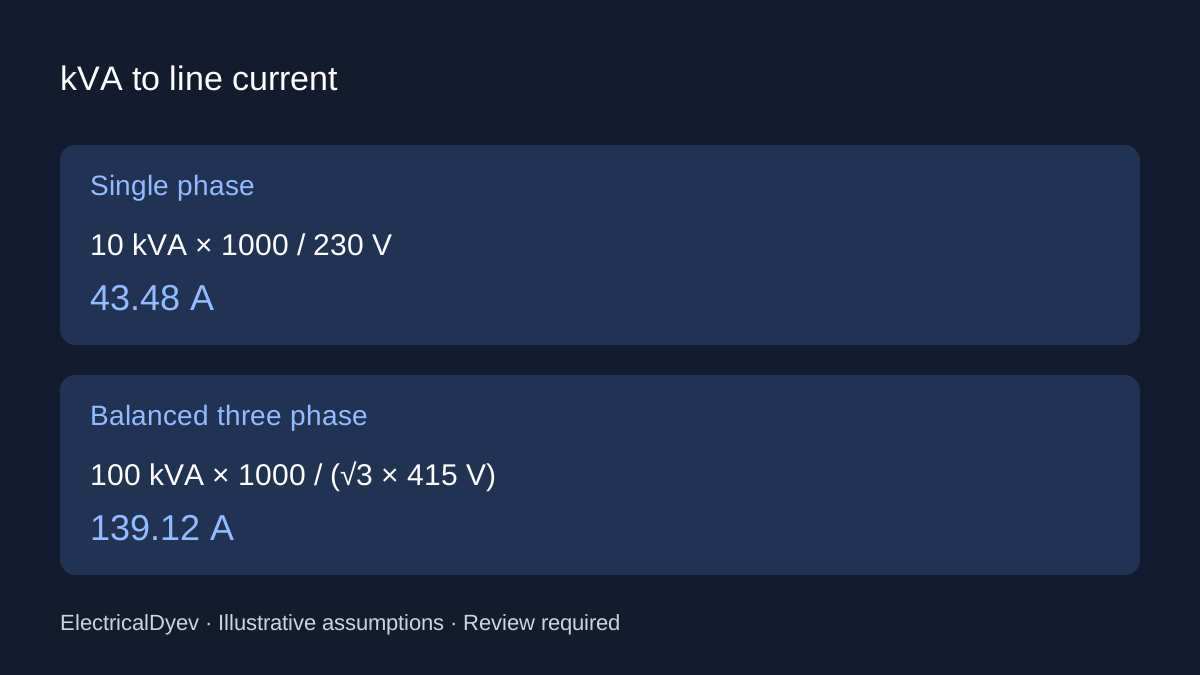
I = S / V = (10 × 1000) / 230 = 43.48 A
Here S is apparent power in VA, V is volts and I is amperes. The factor of 1000 converts kVA to VA. There is no √3 in the single-phase expression. This remains a single-phase calculation if the load is connected between two lines; use its actual terminal voltage rather than assuming it must be 230 V.
At PF 0.8, the corresponding active power is 10 × 0.8 = 8 kW. Current remains 43.48 A. If you then divided that current by 0.8, you would be applying PF to a quantity that already represents apparent power.
Balanced three phase: 100 kVA at 415 V
Use total three-phase apparent power and line-to-line voltage:
IL = S / (√3 × VLL)
IL = 100,000 / (√3 × 415) = 139.12 A
The answer is the line current on each phase under the balanced assumption. Do not divide it by three. The √3 relationship already accounts for expressing total three-phase power using line voltage and line current.
At a different voltage, the same apparent power gives a different current. At 400 V, the example gives 100,000 / (√3 × 400) = 144.34 A. That difference is why a rating cannot be converted into amps without a voltage.
Reading the rating correctly
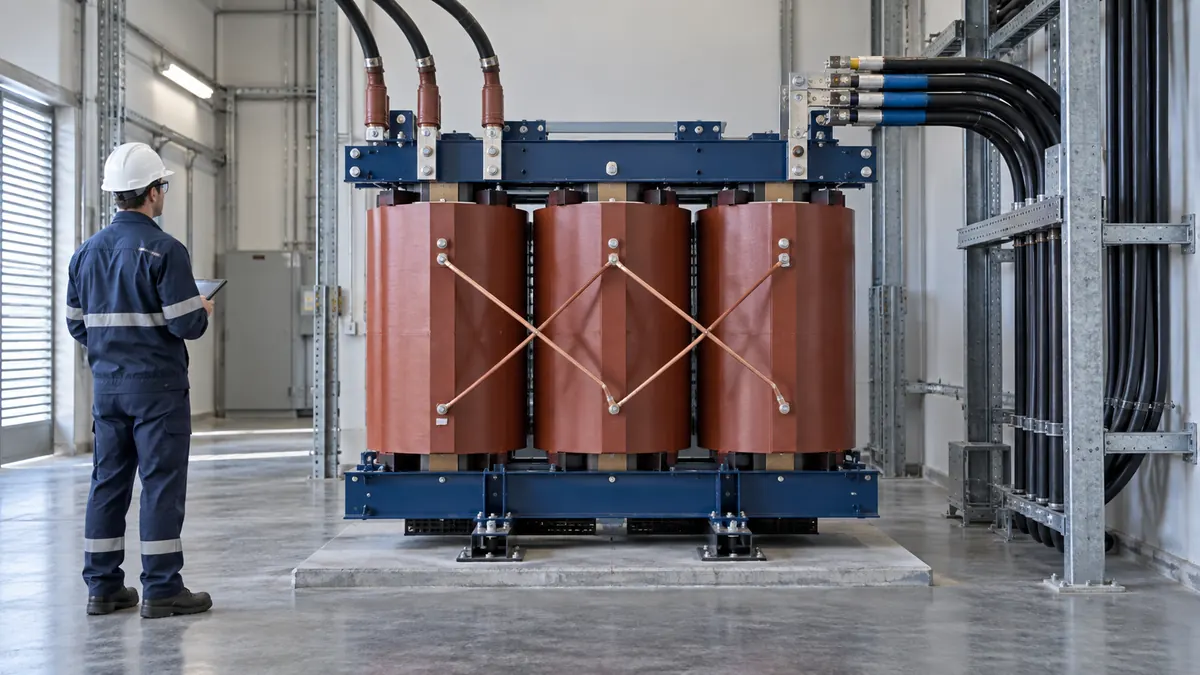
Check whether the stated kVA belongs to the complete three-phase assembly or one individual winding or single-phase unit. Also distinguish a nameplate rating from an operating measurement. A transformer labelled 100 kVA is not necessarily carrying 100 kVA at the moment you inspect it.
For a motor, the prominent kW value can be shaft output. It cannot be substituted for kVA. Electrical input depends on efficiency, and apparent power also depends on PF. Keep that workflow in the motor nameplate guide rather than guessing those quantities.
What to do with the result
Keep the rating, voltage reference and phase arrangement beside the answer. Use manufacturer values if you need a rated current for equipment. Starting, distorted waveforms, unbalance, installation conditions and fault protection require separate checks.
Try another kVA-to-amps example, or use the transformer loading guide when the question is about measured operating load rather than a nameplate rating.
Sources and limits
Preliminary engineering aid only. This is a preliminary rating conversion, not cable selection or protection approval. Confirm equipment data and obtain professional review before installation.
Verify applicable laws, standards, manufacturer data and project conditions with a qualified electrical professional before construction, procurement or regulatory submission.
CONTINUE READING
Related articles
Power and current
kW, kVA and kVAr: what each number tells you
These three quantities are related, but they answer different questions about an AC load and its effect on the supply.
Power and current
Transformer full-load current on the primary and secondary sides
A transformer keeps approximately the same apparent-power rating across both sides, but current changes as voltage changes.
Power and current
Single-Phase Current Calculation: kW and kVA Examples at 230 V
Single-phase current depends on what the power rating means. Electrical kW, apparent kVA and mechanical output need different inputs.