
Measurements and equipment
Reading a Third-Harmonic Current Measurement Before Using It
A display that says 100 A is not telling you the third-harmonic current. Find the spectrum's actual third-order RMS row first.
Explore the measured-component example →Published 25 October 2026
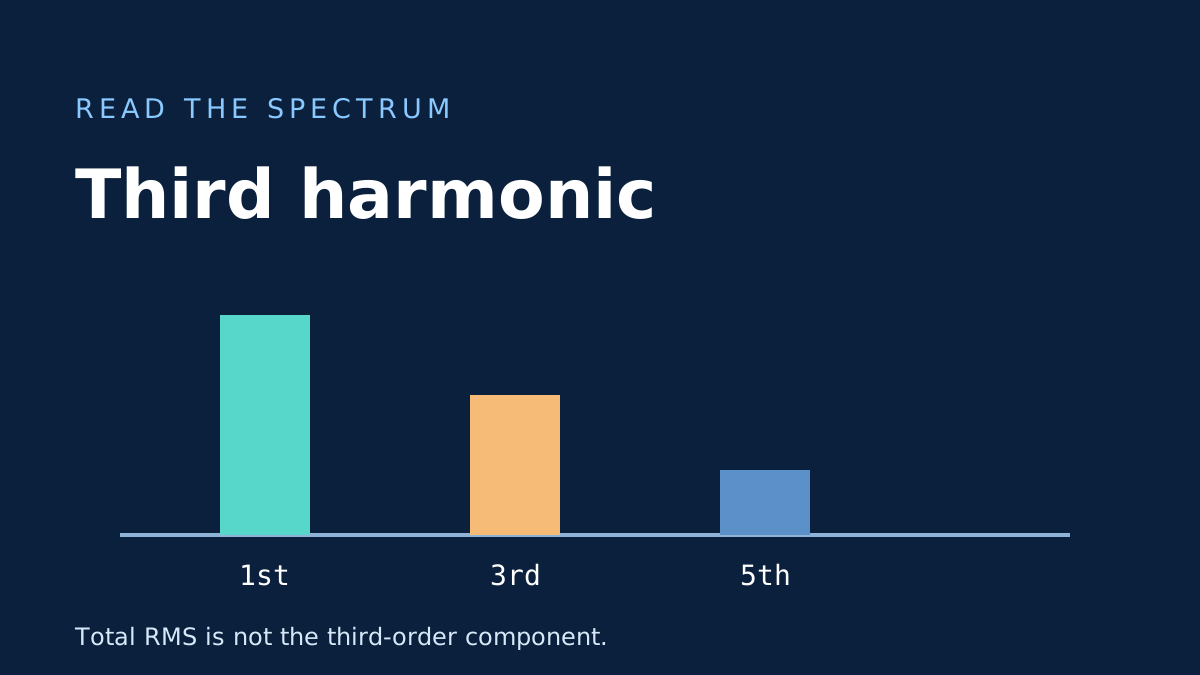
Three current numbers that are easy to confuse
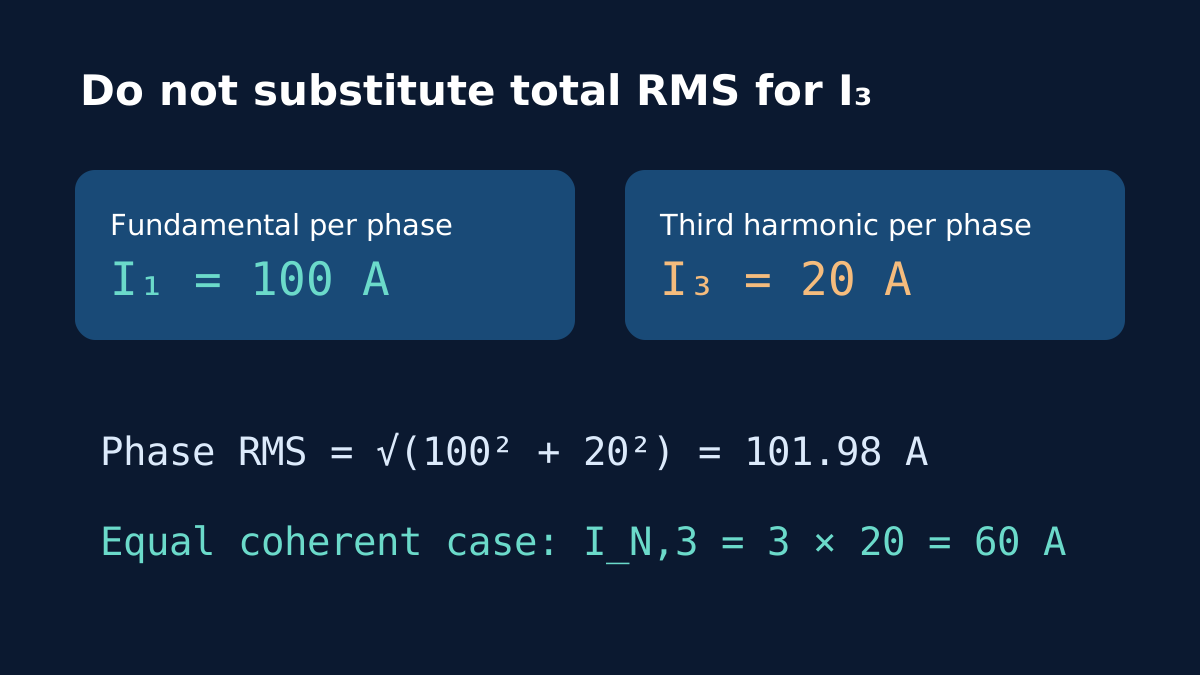
A power-quality instrument may show 102 A total RMS phase current, 100 A at the fundamental frequency, and 20 A at the third harmonic. Those numbers are related, but they are not interchangeable. For this simplified two-component example, √(100² + 20²) = 101.98 A total RMS. The 20 A is the value needed for a third-harmonic component calculation.
The third-harmonic neutral worksheet is deliberately narrow. If all three phases have an equal, phase-coherent 20 A third-harmonic component, the simplified neutral third-harmonic component is 3 × 20 = 60 A. The 100 A fundamental currents cancel only under the stated balanced conditions. The 60 A is not automatically the actual total neutral current.
Check what the instrument means by percentage
Some analysers show each harmonic as amperes; others show a percentage of the fundamental or of total RMS. A display reading “20% third” may mean 20 A only if the reference is a 100 A fundamental. Read the instrument’s definition and record the reference before conversion. Do not enter 20 as amperes merely because the display shows 20%.
Also verify that the three phase measurements belong to the same time window, at the same point in the system, and are actually close enough in magnitude and phase relation for the equal-component example. Schneider Electric explains why triplen components can add in the neutral rather than cancel like a balanced fundamental. Real spectra can contain ninth, fifteenth and other components as well. The fundamental neutral-current calculator answers a different question.
If you only have a clamp meter
A suitable true-RMS clamp can help reveal total current, including the heating effect of a distorted waveform within its specifications. It does not, by that total reading alone, tell you how many amperes belong to the third harmonic. A harmonic-capable power-quality analyser or a verified measurement report is needed for the spectral component. Read what a true-RMS clamp does and does not show before transferring field readings.
Keep the original report, instrument settings, measurement location, operating state and date with the calculation. Unexpected neutral readings need an actual measurement and professional review, not a fitted percentage chosen to make the worksheet agree.
Sources and limits
Preliminary engineering aid only. The equal-third-harmonic illustration requires a supportable measurement basis. It does not calculate total neutral current or select a neutral conductor.
Verify applicable laws, standards, manufacturer data and project conditions with a qualified electrical professional before construction, procurement or regulatory submission.
CONTINUE READING
Related articles
Power and current
Three-Phase Neutral Current: Formula and Worked Example
100 A, 80 A and 60 A produce a 34.64 A fundamental neutral-current estimate at 120° separation; harmonics need a separate check.
Measurements and equipment
What Is a Normal Neutral Current in a Three-Phase System?
A balanced fundamental can cancel in the neutral while harmonic current remains. Interpret the reading before comparing it with a simple calculation.
Measurements and equipment
A True-RMS Clamp Reading Is Not a Harmonic Spectrum
True-RMS is valuable for a distorted current waveform, but it does not identify which frequency components produced the number.