
Measurements and equipment
A True-RMS Clamp Reading Is Not a Harmonic Spectrum
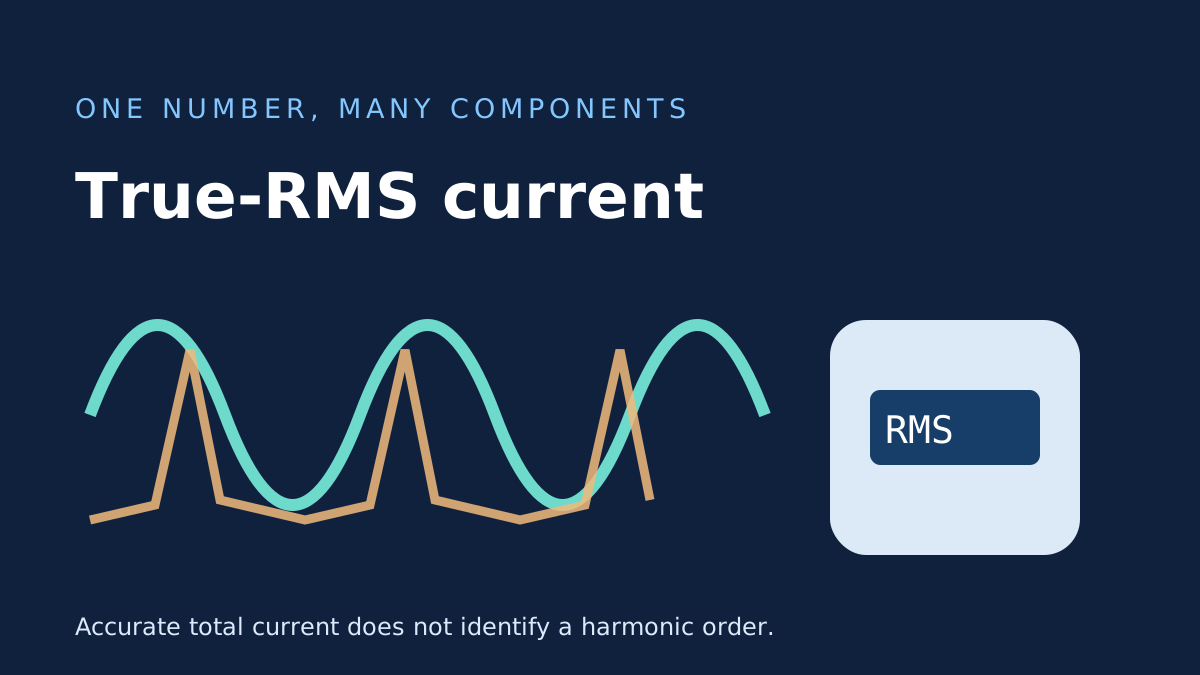
True-RMS is valuable for a distorted current waveform, but it does not identify which frequency components produced the number.
See the harmonic-component worksheet →Published 25 October 2026
The number is useful—but it answers one question
A true-RMS clamp meter can report the effective RMS current of a distorted waveform within its rated bandwidth and crest-factor limits. That is more appropriate than treating a heavily distorted waveform as a perfect sine wave. Fluke’s guidance explains why an average-responding meter may give a misleading result on such loads.
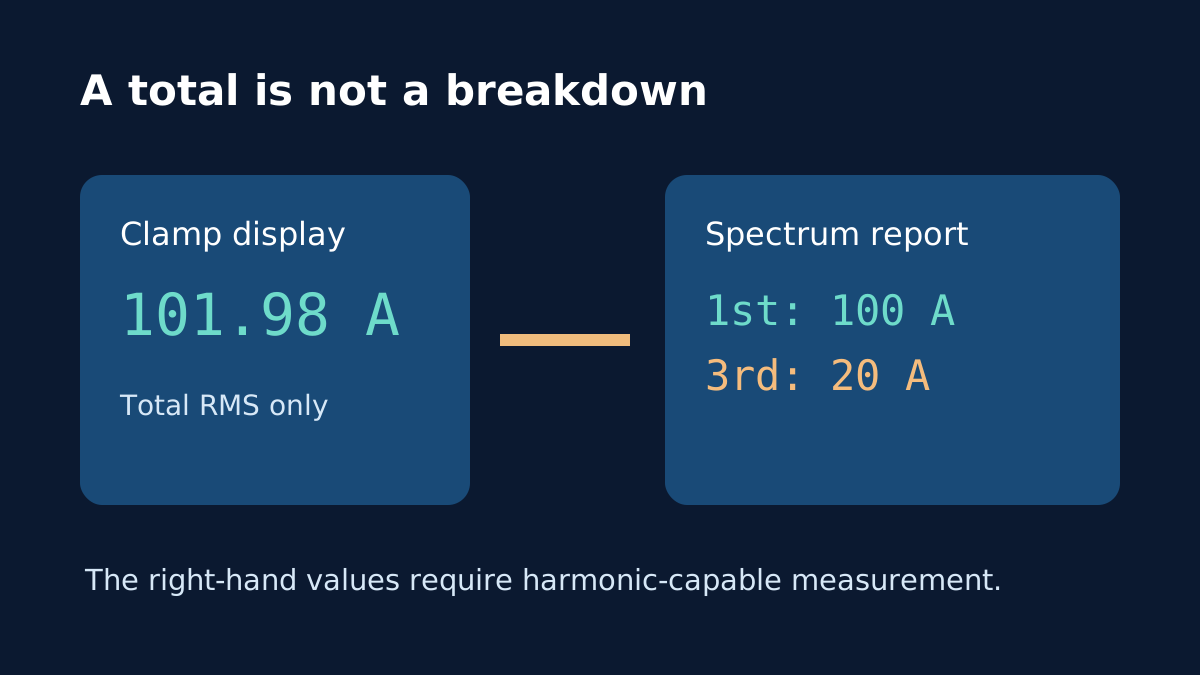
But a display of “102 A” does not reveal whether most of that current is at the 50 Hz fundamental, the third harmonic, the fifth harmonic or another frequency. It also says nothing about the relative phase of harmonic components on three lines. The third-harmonic worksheet therefore asks for a measured third-order RMS component, not a total clamp reading.
A small numerical illustration
Imagine a simplified phase current made of 100 A RMS fundamental and 20 A RMS third harmonic. If those are orthogonal frequency components, the total is √(100² + 20²) = 101.98 A RMS. Entering 101.98 A as “third harmonic” would be a serious error: the third component in this example is 20 A. In the equal, coherent three-phase example, it could produce a 60 A third-harmonic neutral component. That is still not a conductor-sizing result.
What to record in the field report
Record the instrument model, mode, range, bandwidth or filtering settings, measurement point, operating condition and time. If a report includes harmonic percentages, document the percentage basis before converting to amperes. A changing load may need logged data rather than one snapshot. Do not open energized equipment or move clamps based on this article; qualified personnel must follow site procedures and equipment instructions.
The clamp-meter amps versus kW guide covers a separate limitation: even an accurate RMS current is not active power unless voltage and the appropriate power-factor information are also known. For an unexpected neutral current, compare a real neutral measurement with a professionally interpreted spectrum rather than trying to reverse-engineer harmonic content from total phase amps.
Sources and limits
Preliminary engineering aid only. Instrument category, range, bandwidth and measurement method must be suitable for the installation. This page is not a live-electrical-work instruction.
Verify applicable laws, standards, manufacturer data and project conditions with a qualified electrical professional before construction, procurement or regulatory submission.
CONTINUE READING
Related articles
Measurements and equipment
Reading a Third-Harmonic Current Measurement Before Using It
A display that says 100 A is not telling you the third-harmonic current. Find the spectrum's actual third-order RMS row first.
Measurements and equipment
A clamp meter shows amps, not kW
The clamp reading is valuable, but it is one input. Voltage, phase arrangement, power factor and timing complete the power estimate.
Measurements and equipment
What Is a Normal Neutral Current in a Three-Phase System?
A balanced fundamental can cancel in the neutral while harmonic current remains. Interpret the reading before comparing it with a simple calculation.