
Measurements and equipment
A clamp meter shows amps, not kW
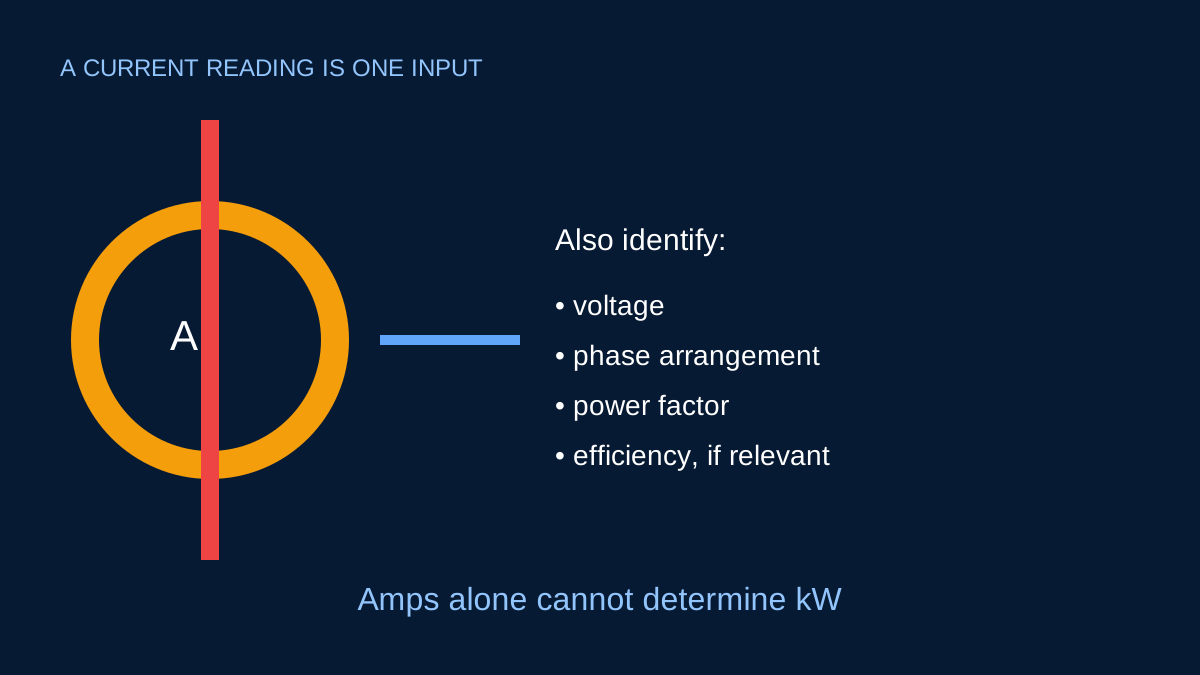
The clamp reading is valuable, but it is one input. Voltage, phase arrangement, power factor and timing complete the power estimate.
Estimate kW from a current reading →Published 26 September 2026
What the jaws are sensing
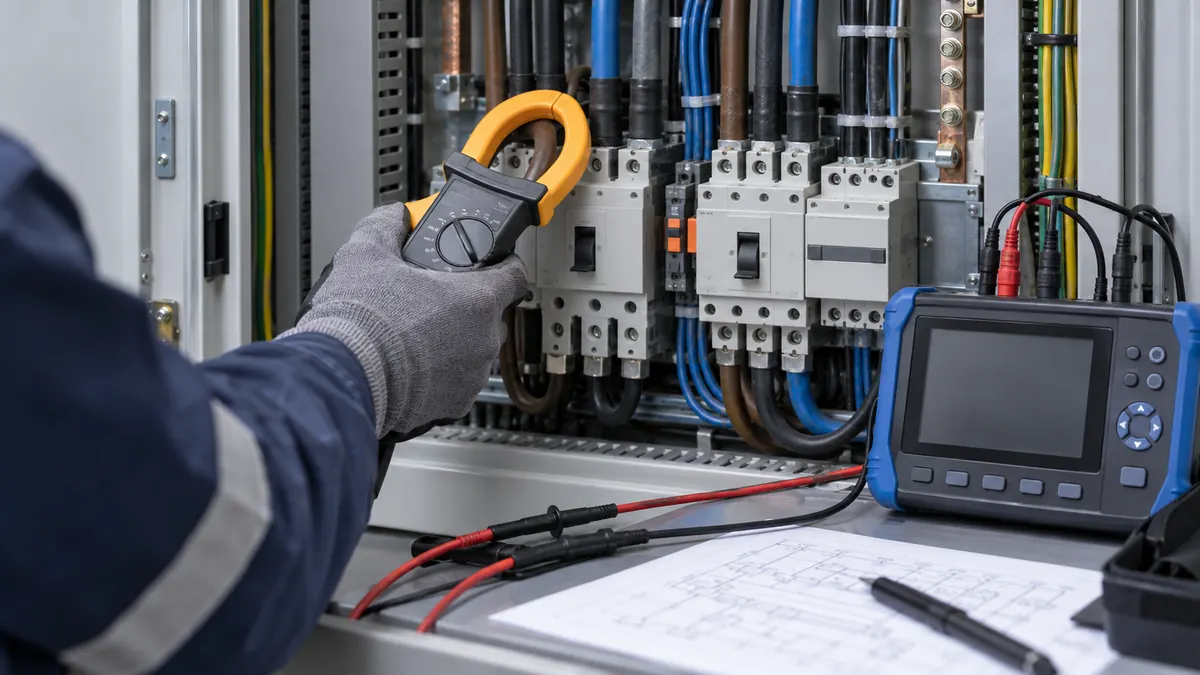
An AC clamp meter detects the magnetic field produced by current in a conductor. It can measure current without opening the circuit, which makes it practical for many field checks. The display does not automatically know the circuit voltage, phase arrangement, power factor or what the load is doing mechanically.
Clamping around all conductors of a normal circuit together can make their fields cancel. Current measurement is normally made around the intended single conductor, following the instrument instructions and safe work practices.
Why 10 A has several kW answers
At 230 V single phase and power factor 0.80:
P = 230 × 10 × 0.80 = 1.84 kW
At 415 V balanced three phase and the same power factor:
P = √3 × 415 × 10 × 0.80 = 5.75 kW
The clamp reading is identical. The system context is not.
True RMS and waveform shape
Electronic loads and drives can draw distorted current. Instrument capability matters when the waveform is not a clean sine wave. A true-RMS current reading improves the current measurement, but active power still requires the relationship between voltage and current waveforms. An assumed displacement power factor may not capture distortion effects.
Use a power-quality instrument or power analyser when the task requires accurate active power, harmonics or phase-by-phase power.
Timing matters
Motor starting current can be much larger than running current and may last briefly. A general reading taken after startup cannot describe inrush. Likewise, a compressor, heater bank or process line can cycle through several load states.
Record whether the reading represents startup, steady operation, minimum load or peak demand. For three phase, measure all phases when imbalance is possible.
A good field note
Alongside current, record voltage at the same operating state, phase arrangement, phase identification, equipment status, time and whether power factor was measured or assumed. These notes make an amps-to-kW estimate reviewable.
The calculator can turn that matched information into a transparent estimate. It should not be used to claim energy consumption, mechanical output or equipment efficiency from current alone.
What the clamp actually measures
A clamp meter senses the magnetic field around a conductor. Clamp one current-carrying conductor, not an entire single-phase cable containing both outgoing and return conductors: the opposing fields can cancel. On a three-phase circuit, measure each line separately and label it.
Instrument category, current range, true-RMS capability, bandwidth and waveform crest factor influence whether the displayed number is meaningful. Measurements on variable-speed-drive outputs require equipment and methods suitable for the waveform. Follow safe working practices and instrument instructions; a convenient jaw opening is not permission to access live conductors.
Add voltage and power factor to estimate kW
For a 230 V single-phase load drawing 8 A at PF 0.75:
P = 230 × 8 × 0.75 = 1,380 W
The apparent power is 1.84 kVA. Assuming unity PF would report 1.84 kW—one-third higher than the stated example. Current and voltage alone therefore do not determine active AC power.
For balanced three phase, the corresponding relationship is P = √3 × VLL × IL × PF. Confirm that the voltage and current were measured during the same load condition.
A single reading is a snapshot
Compressors cycle, heaters stage, pumps modulate and production machinery changes with process load. Inrush and acceleration can briefly dominate a display. If the question concerns maximum demand, energy or typical loading, log over an appropriate interval instead of selecting one instant.
Min/max features can be helpful, but the capture settings and duration still matter. Write down whether a value is instantaneous, averaged, peak-held or logged. “12 A” without time context can refer to very different operating realities.
When to use a power analyser
Use suitable power instrumentation when you need measured kW, kVA, kVAr, PF, harmonics, energy or phase-by-phase balance. A power analyser samples voltage and current together and evaluates their relationship; a current-only clamp cannot reconstruct information it never observed.
The amps-to-kW calculator remains useful for planning and cross-checking. Its strongest output is not extra decimals but a visible record of which voltage, phase and PF assumptions produced the estimate.
Sources and limits
Preliminary engineering aid only. Electrical measurement can expose hazardous energy and must use suitable instruments, PPE, procedures and competent personnel.
Verify applicable laws, standards, manufacturer data and project conditions with a qualified electrical professional before construction, procurement or regulatory submission.
CONTINUE READING
Related articles
Power and current
How to estimate kW from amps without hiding the assumptions
Current alone is not power. Voltage, phase arrangement and power factor determine what a measured ampere value can tell you about kW.
Power and current
From clamp-meter amps to kW: worked examples at 230 V and 415 V
A current reading becomes useful power information only when voltage, phase arrangement and power factor come from the same operating condition.
Measurements and equipment
Reading a motor nameplate before calculating current
A nameplate already contains many of the assumptions a calculator would otherwise have to guess. Read them as one matched rating set.