
Power and current
Balanced three-phase current: the preliminary calculation
A transparent explanation of the familiar √3 relationship, the voltage that belongs in it and the conditions under which it is useful.
Open the three-phase current calculator →Published 15 September 2026
The relationship in one line
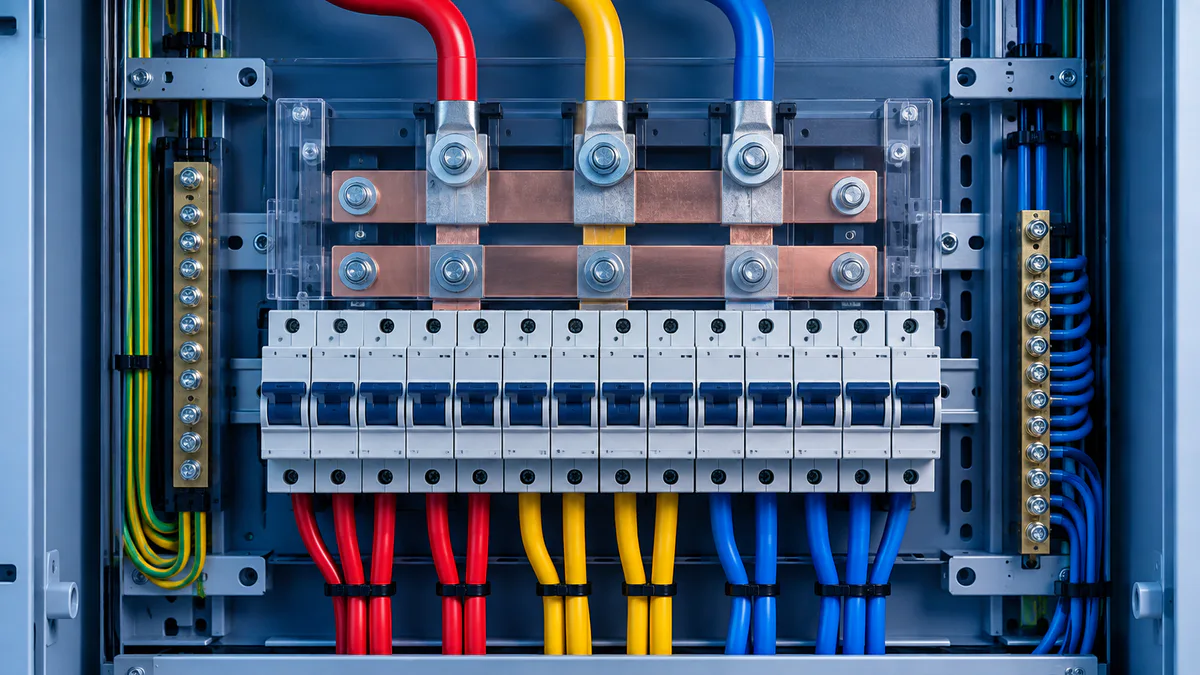
For a balanced three-phase load, apparent power is S = √3 × VLL × IL. Active power adds power factor: P = √3 × VLL × IL × PF. Rearranging gives the line current.
The voltage is line-to-line voltage. The current is line current. Mixing phase-to-neutral voltage with the √3 formula is a common way to create a result that is wrong by the same √3 factor.
Worked example
For 10 kW at 415 V line-to-line and 0.80 power factor:
I = 10,000 / (√3 × 415 × 0.80) = 17.39 A
For 10 kVA at the same voltage, power factor is not needed to determine current:
I = 10,000 / (√3 × 415) = 13.91 A
The two ratings describe different quantities. kW is active power; kVA is apparent power. A device can have the same kW but draw more current when its power factor is lower.
What “balanced” really means
The formula assumes the three phase currents have equal magnitude and the expected phase displacement. Real installations rarely match perfectly. A modest imbalance may still make the formula useful as an initial design value, but phase-by-phase measurements or a more detailed study are needed when the loads differ substantially.
Nonlinear loads add another complication. Their current waveforms may contain harmonics, and some harmonic components behave differently in the neutral and conductors. The simple current formula cannot describe that waveform.
Use the result in sequence
The result can feed a preliminary load schedule, a voltage-drop calculation or a custom-data cable comparison. Those later steps introduce their own inputs: route length, impedance, installation method, correction factors and protection requirements.
The calculator deliberately displays the equation, formula ID and assumptions. If a reviewer changes voltage, power factor or the meaning of the power rating, the reason for the changed current remains clear.
Before relying on the number
Confirm the nameplate quantity, supply voltage, operating power factor and whether the stated load is input or mechanical output. For motors and transformers, include starting, inrush and protection studies separately. A correct arithmetic result is only one part of an electrical design.
Sources and limits
Preliminary engineering aid only. The balanced formula does not represent starting current, phase unbalance, harmonic current or fault current.
Verify applicable laws, standards, manufacturer data and project conditions with a qualified electrical professional before construction, procurement or regulatory submission.
CONTINUE READING
Related articles
Power and current
Why √3 appears in three-phase power calculations
The √3 factor is geometry, not a memorised correction. It connects phase quantities with line quantities in a balanced system.
Power and current
Line Current vs Phase Current in Star and Delta Connections
Star: line current equals winding current. Delta: line current is √3 times branch current, assuming balanced sinusoidal operation.
Power and current
Line-to-Line vs Line-to-Neutral Voltage: Formula and Examples
In an ideal balanced star system, line-to-line voltage is √3 times line-to-neutral voltage. The measurement points still matter.