
Power and current
Power Factor and Motor Efficiency Are Not the Same Number
Both affect a motor-current estimate, but at different steps. Mixing them can hide the power basis or apply a factor twice.
Compare a 20 kW current estimate →Published 25 October 2026
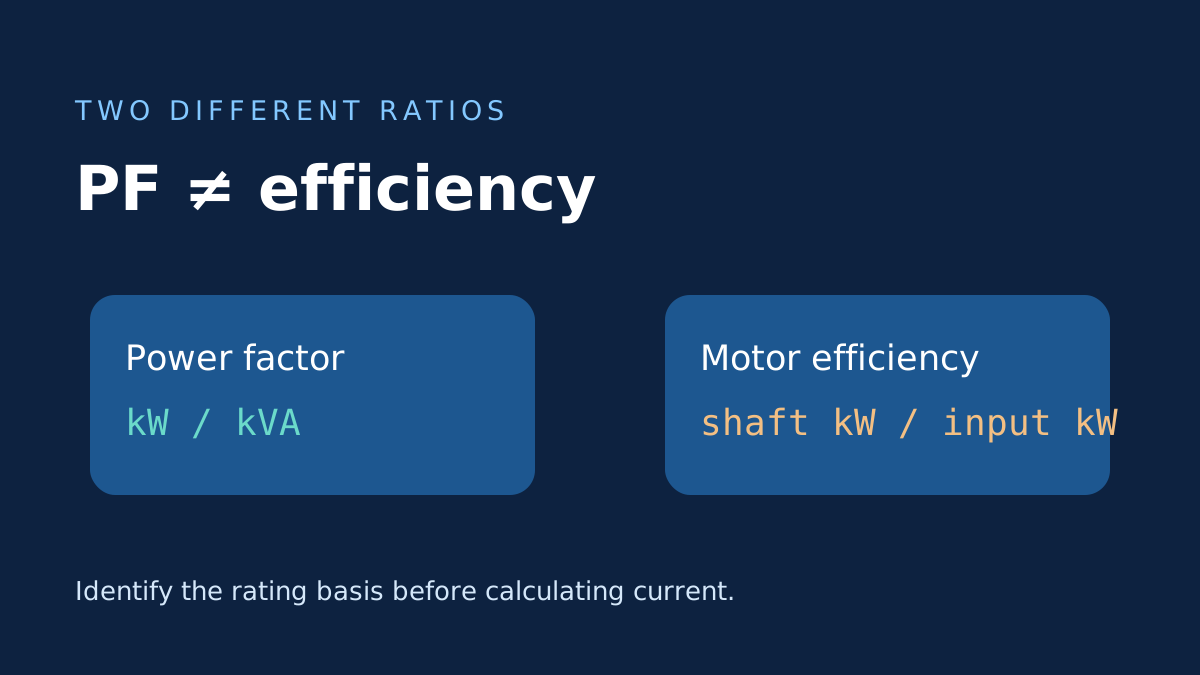
They answer two different questions
Motor efficiency compares useful mechanical shaft output with active electrical input. Power factor compares active electrical power with apparent electrical power. Both are ratios between zero and one in these ordinary example calculations, but they do not describe the same loss or the same part of the system.
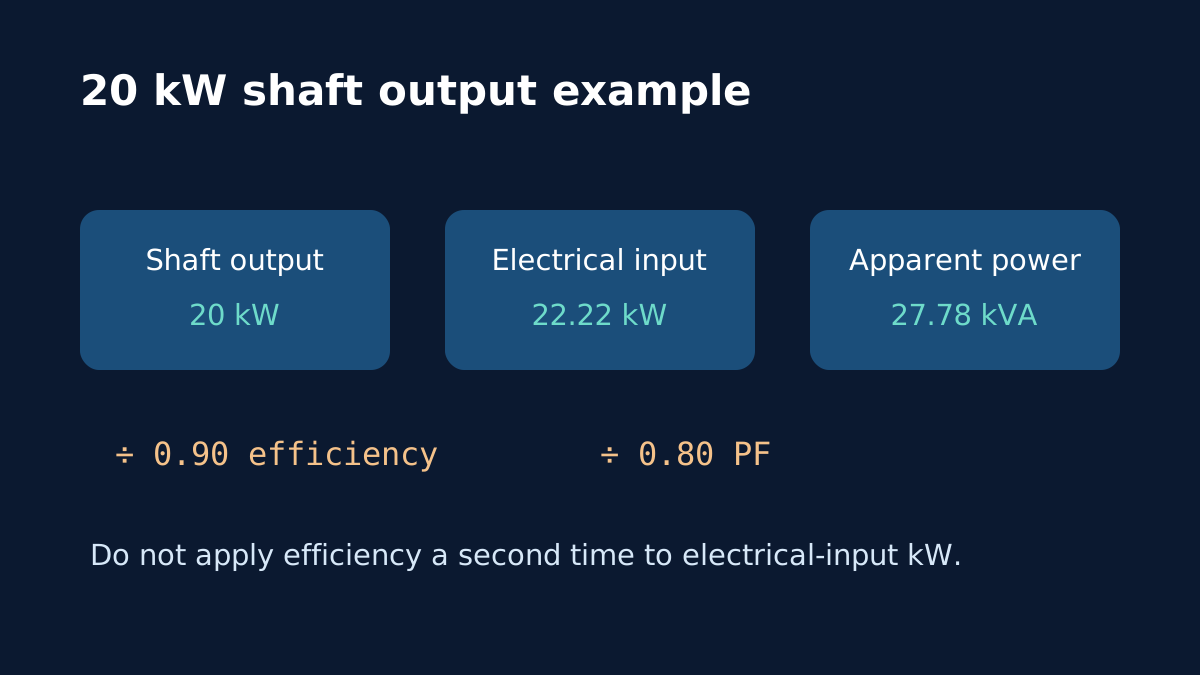
If a motor’s 20 kW rating is shaft output and its efficiency at that operating point is 0.90, the required active electrical input is 20 / 0.90 = 22.22 kW. At 415 V line-to-line and PF 0.80, the balanced three-phase line-current estimate is 22,222 / (√3 × 415 × 0.80) ≈ 38.64 A.
If the 20 kW instead already means electrical input, efficiency is not applied again. The same voltage and PF give about 34.78 A. This is why the 20 kW to amps article keeps the power basis beside the answer.
Changing only one factor
Keep the shaft output and 0.90 efficiency, but assume PF 0.90 instead of 0.80. Active input remains about 22.22 kW; the line-current estimate falls to about 34.35 A because less apparent power is needed for the same active power. That does not mean the motor has become 90% more efficient or that its mechanical output has changed.
Now keep PF 0.80 but change the assumed efficiency. The active input and current both change. Neither factor should be chosen merely to match a desired answer. Use the motor manufacturer’s operating data or measured electrical input where possible.
A practical entry order
- Identify whether the available kW or horsepower is shaft output or electrical input.
- Apply efficiency only to convert output to input when justified.
- Use the applicable supply voltage and PF to calculate steady electrical current.
- Keep starting current, actual loading, waveform distortion and nameplate current as separate checks.
The horsepower guide handles the same output-to-input issue for hp ratings. The current result is not a breaker, cable or energy-consumption decision.
Sources and limits
Preliminary engineering aid only. The numerical efficiency and power factor are illustrative assumptions, not ratings for any specific motor or a basis for protection selection.
Verify applicable laws, standards, manufacturer data and project conditions with a qualified electrical professional before construction, procurement or regulatory submission.
CONTINUE READING
Related articles
Power and current
20 kW to Amps at 415 V: Three-Phase Worked Example
At 415 V three phase, 20 kW electrical input gives 34.78 A at power factor 0.80; shaft output requires an efficiency adjustment.
Power and current
Horsepower to electrical input: where efficiency belongs
A motor’s shaft output is smaller than its electrical input. Correct conversion begins by identifying which side of the machine the rating describes.
Power and current
Why current rises when power factor falls
Power factor changes current without changing the active kW requirement. A short table makes the effect easy to see.