
Power and current
Can Power-Factor Correction Reduce kWh or Only kVA Charges?
A lower kVA demand can affect some tariffs, but it does not automatically reduce a meter's kWh total or every electricity bill.
Compare PF before and after →Published 25 October 2026
Lower current is not the same as lower energy use
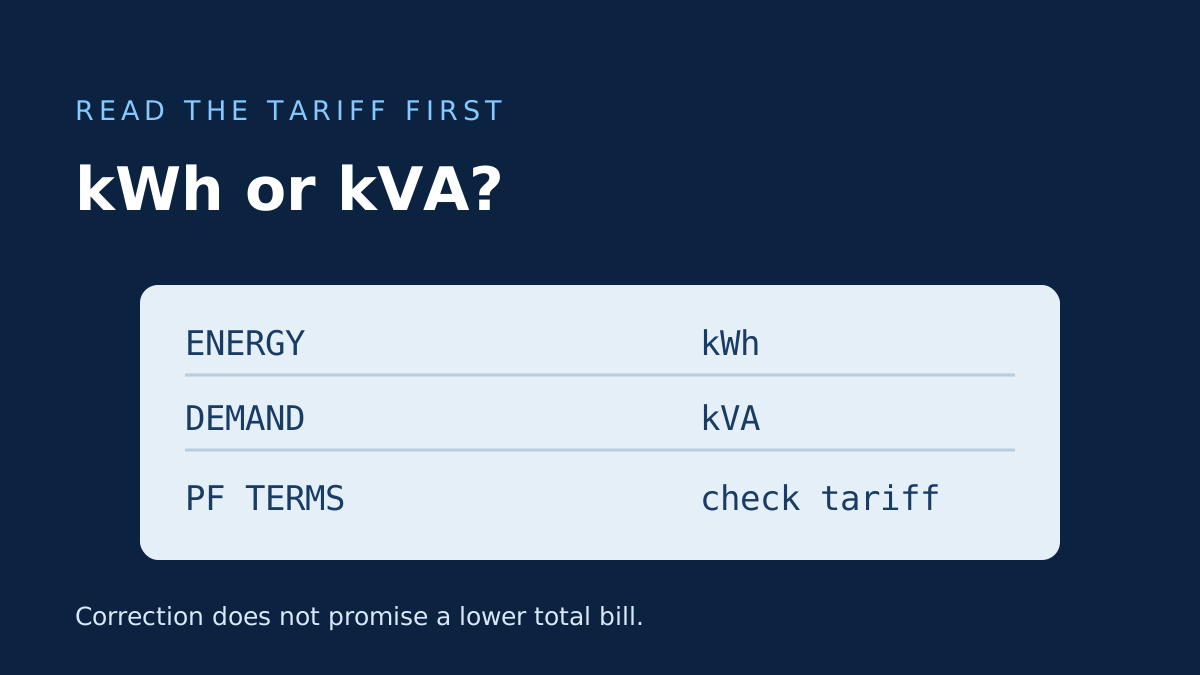
Improving displacement power factor can reduce current and apparent-power demand for a given active load. It does not by itself guarantee that the machine performs less useful work or that a kWh meter records fewer units. A bill may include active-energy charges, demand charges, PF penalties, fixed charges and taxes; which lines change depends on the actual tariff.
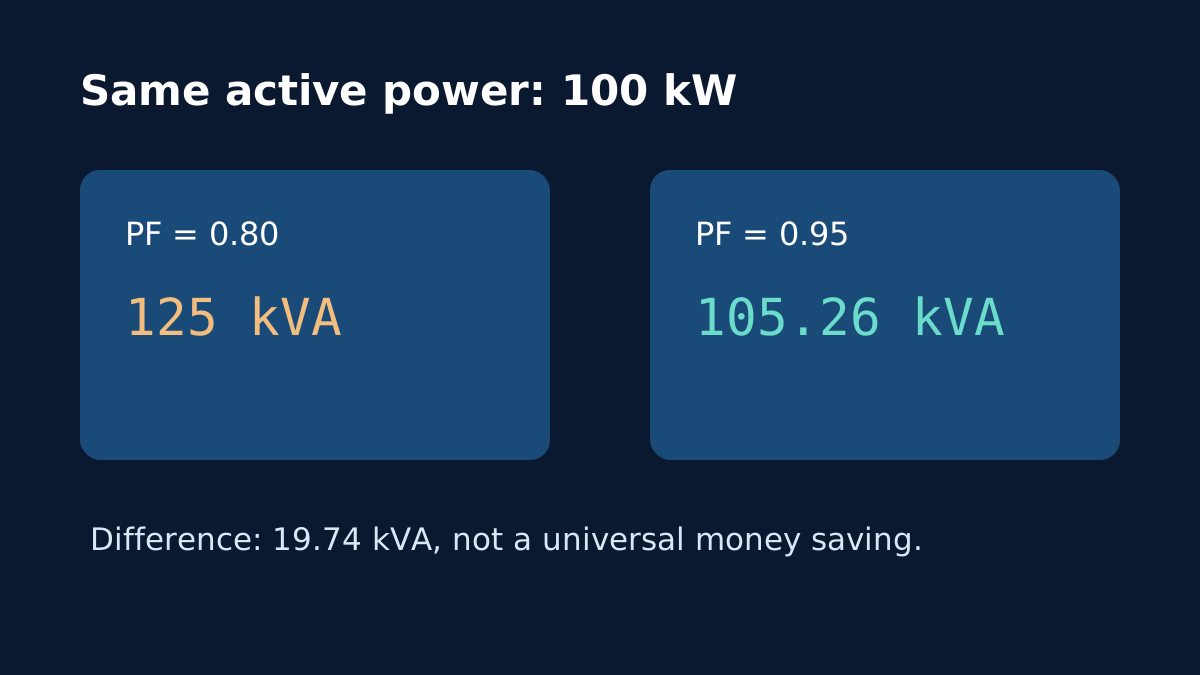
The power-factor correction calculator shows the electrical quantities, not a promised monetary saving. For 100 kW steady active load, PF 0.80 gives 100 / 0.80 = 125 kVA. At PF 0.95, it gives 100 / 0.95 = 105.26 kVA. The apparent-demand difference is about 19.74 kVA while the assumed active load remains 100 kW.
What happens on a bill?
If a tariff actually bills a kVA maximum-demand component at a documented rate, a lower measured billing demand could change that line. The arithmetic would use the billed demand difference and the applicable tariff rate, not a generic percentage of the whole bill. It also depends on when the monthly peak occurs and whether the correction is operating then.
If the bill charges only for kWh and fixed items, the 19.74 kVA arithmetic does not establish any direct bill reduction. The US Department of Energy’s worked utility-bill example explicitly distinguishes cost effects from energy savings. The point applies broadly, but the tariff in that example is not an Indian tariff and must not be copied into a local estimate.
Before projecting savings
Collect several representative bills, their rate schedule, interval demand or meter data, measured PF over operating conditions, and the operating pattern of the relevant loads. Then separate the charges that are actually sensitive to PF from those that are not. A simplistic kVAr × price calculation usually uses the wrong unit or ignores the tariff design.
Capacitor-bank selection also requires harmonic, resonance, switching and equipment assessment. The kVAr explanation is a starting point for that discussion, not a purchase instruction.
Sources and limits
Preliminary engineering aid only. Tariff rules differ by utility and customer category. No financial saving or capacitor specification can be inferred without a real bill and specialist review.
Verify applicable laws, standards, manufacturer data and project conditions with a qualified electrical professional before construction, procurement or regulatory submission.
CONTINUE READING
Related articles
Power and current
How much kVAr is needed to improve power factor?
The kVAr formula is straightforward. Choosing equipment safely still requires harmonic, resonance and switching studies.
Power and current
Why current rises when power factor falls
Power factor changes current without changing the active kW requirement. A short table makes the effect easy to see.
Power and current
kW, kVA and kVAr: what each number tells you
These three quantities are related, but they answer different questions about an AC load and its effect on the supply.