
Power and current
Does a 20 kW Motor Use 20 Electricity Units per Hour?
Twenty kilowatts on a motor is not automatically twenty kilowatt-hours on the meter every hour; rating basis and actual loading matter.
Estimate an operating interval →Published 25 October 2026
First ask what the 20 kW describes
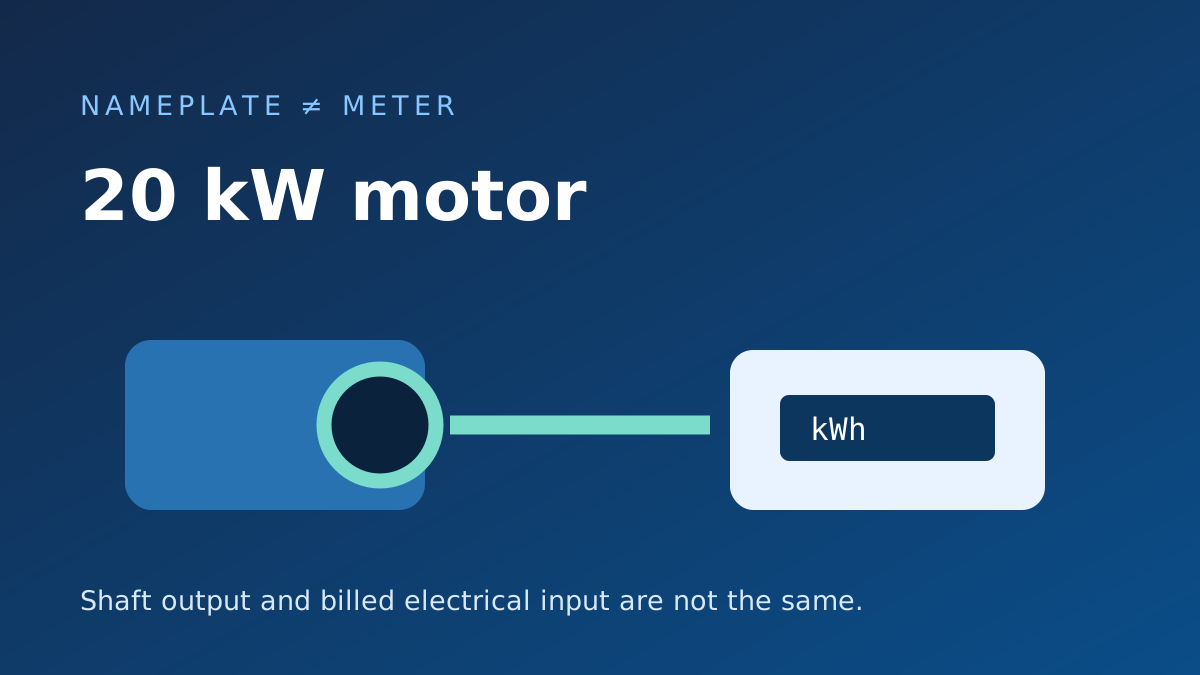
On many motor nameplates, 20 kW describes rated mechanical shaft output. Electricity enters the motor; some becomes heat and other losses; the remaining power reaches the shaft. A 20 kW shaft output therefore requires more than 20 kW of electrical input at rated operation.
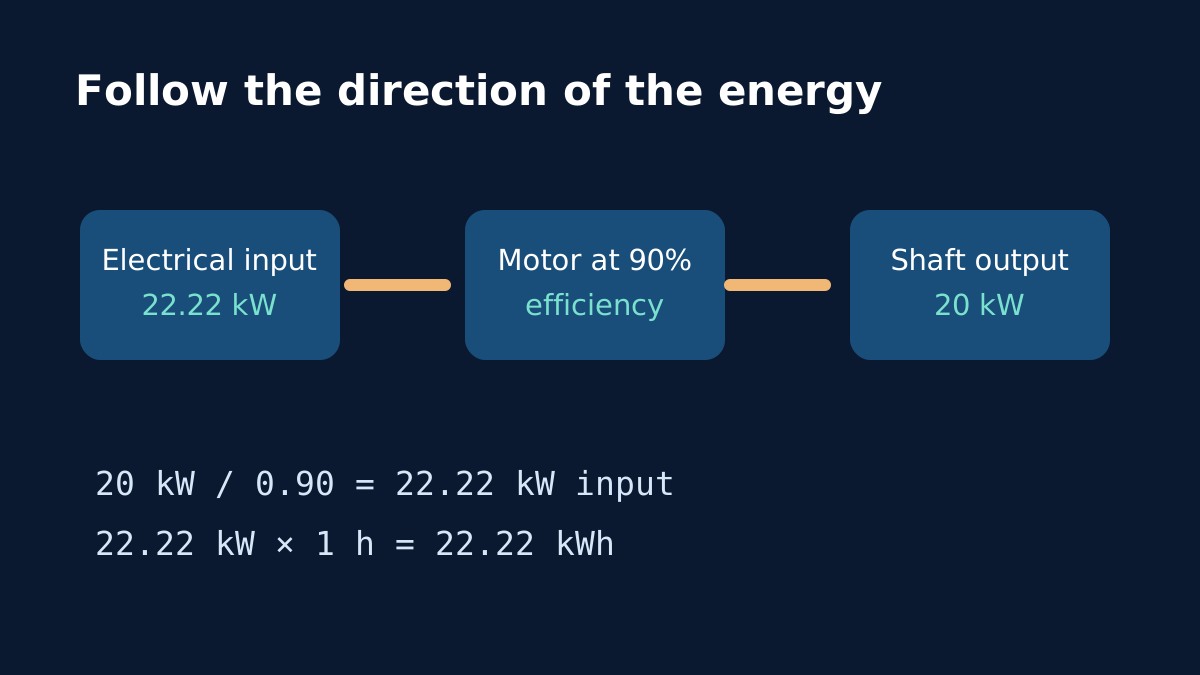
If rated efficiency were 90%, the arithmetic would be Pinput = Pshaft / efficiency = 20 / 0.90 = 22.22 kW. One hour at that exact electrical operating point would use about 22.22 kWh, not 20 kWh. This is a worked assumption, not a claimed efficiency for a real motor. The 20 kW to amps example uses the same distinction when converting power to current.
The nameplate is not an operating log
A motor may spend much of its day below rated shaft output. Suppose a suitable power analyser actually measures 12 kW electrical input during a stable operating interval. If the same condition lasts one hour, the interval estimate is 12 kWh. It would be wrong to force the nameplate’s 20 kW output into that measured input calculation. It would also be wrong to say the machine always uses 12 units per hour on the basis of one brief reading.
The Bureau of Energy Efficiency’s motor example separates rated output, rated input and measured operating input. That is the right mental model: these are related but different quantities. Power factor affects the current needed for a given active input; efficiency relates electrical input to mechanical output. They must not be swapped.
Put a time period beside every number
Kilowatts express a rate of energy use. Kilowatt-hours express energy across a period. “20 units per hour” is shorthand that only holds if active electrical input really is 20 kW throughout that hour. Over a day with changing loading, add separate interval estimates or use a meter.
Use the amps-to-kWh calculator only with representative electrical operating current, voltage, PF and duration. If all you have is a shaft-output nameplate, first obtain a supportable efficiency and loading basis; better still, measure electrical input at the actual operating point. For a changing process, see the interval method.
Sources and limits
Preliminary engineering aid only. Motor efficiency and loading vary with operating condition. The examples are arithmetic illustrations, not a prediction of this equipment's consumption or bill.
Verify applicable laws, standards, manufacturer data and project conditions with a qualified electrical professional before construction, procurement or regulatory submission.
CONTINUE READING
Related articles
Power and current
20 kW to Amps at 415 V: Three-Phase Worked Example
At 415 V three phase, 20 kW electrical input gives 34.78 A at power factor 0.80; shaft output requires an efficiency adjustment.
Power and current
Horsepower to electrical input: where efficiency belongs
A motor’s shaft output is smaller than its electrical input. Correct conversion begins by identifying which side of the machine the rating describes.
Measurements and equipment
A Changing Load Needs More Than One Amps-to-kWh Reading
A pump that starts, idles and runs at full load does not draw one current all day. A short interval worksheet gives a more honest energy estimate.