
Measurements and equipment
A Changing Load Needs More Than One Amps-to-kWh Reading
A pump that starts, idles and runs at full load does not draw one current all day. A short interval worksheet gives a more honest energy estimate.
Calculate one operating interval →Published 25 October 2026
The eight-hour shortcut can be misleading
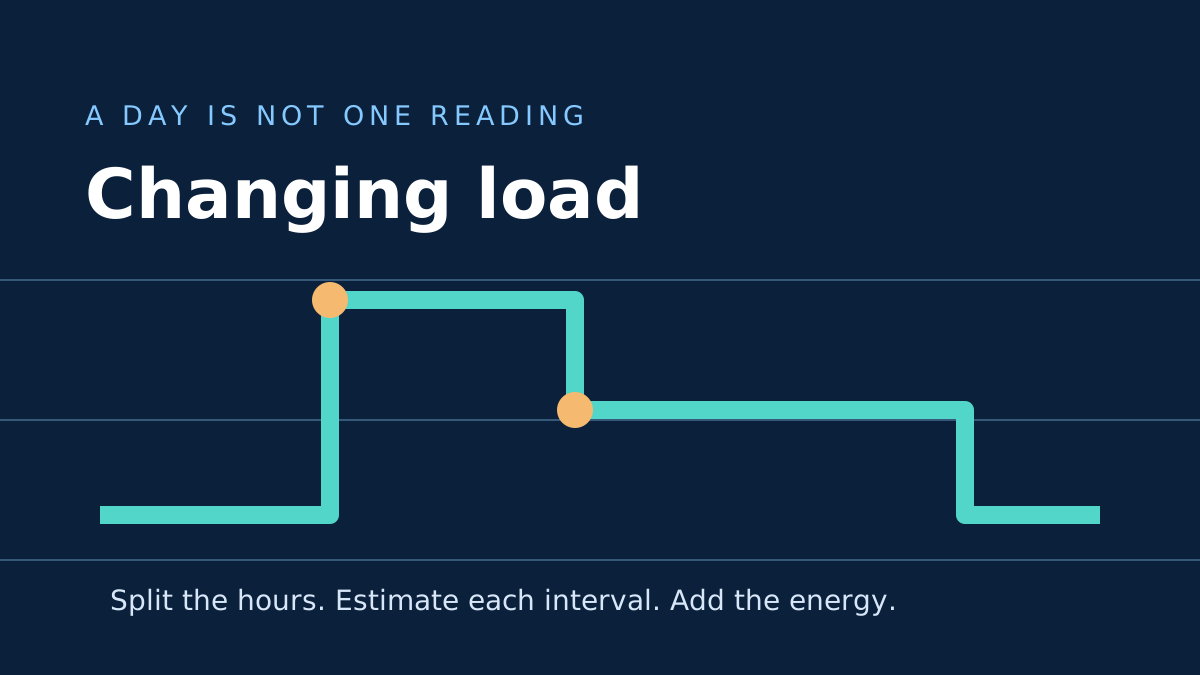
A technician measures 20 A at a three-phase motor and writes “20 A for eight hours.” That may be true for a continuous process, but not for a pump that alternates between full flow, reduced flow and off. The arithmetic can be perfect while the assumed operating history is wrong.
The amps-to-kWh calculator intentionally models one steady interval. It does not pretend to reconstruct a day from one sample. To estimate a changing day, divide it into intervals that have representative readings, calculate each interval, and add the energy values.
A transparent three-interval example
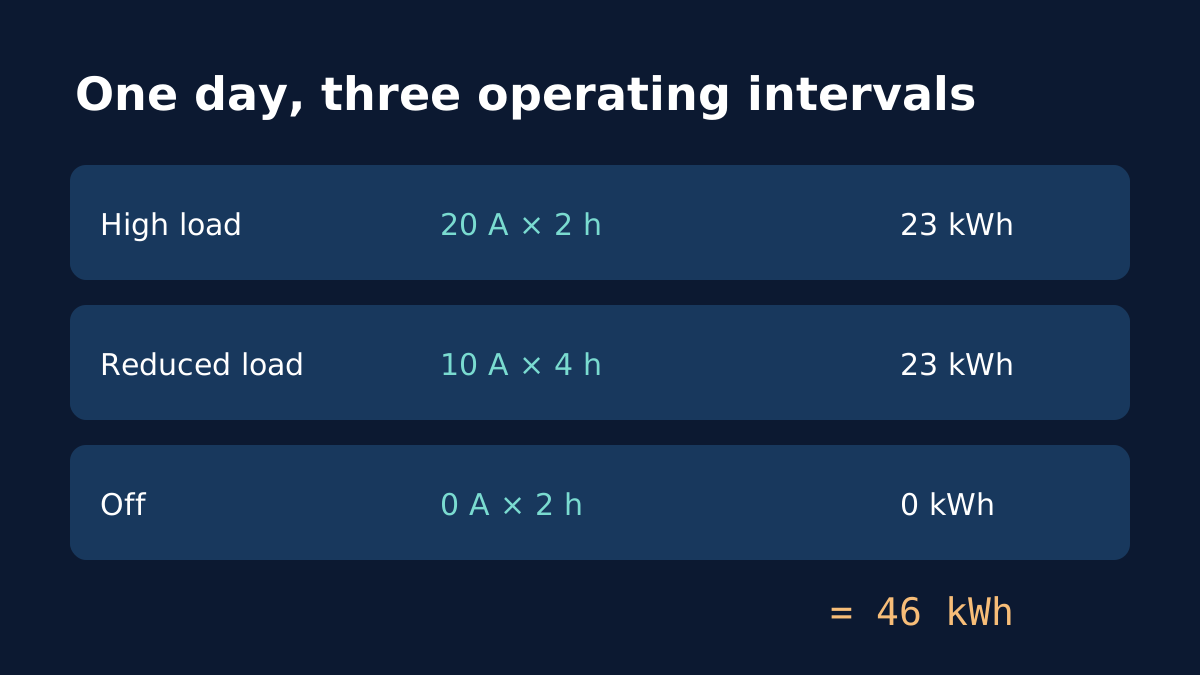
Assume balanced three-phase operation at 415 V and an operating power factor of 0.80 for each interval. This is a simplified example; in practice, PF and voltage may also change.
| Operating condition | Line current | Duration | Estimated active power | Energy |
|---|---|---|---|---|
| High load | 20 A | 2 h | 11.50 kW | 23.00 kWh |
| Reduced load | 10 A | 4 h | 5.75 kW | 23.00 kWh |
| Off | 0 A | 2 h | 0 kW | 0 kWh |
The total is approximately 46.0 kWh. Treating the 20 A high-load reading as though it lasted all eight hours would produce about 92.0 kWh—double this simplified interval estimate. Enter the high-load and reduced-load cases separately; an off interval contributes zero without needing a calculator result.
Record the measurement basis
For every row, note the time, where current was measured, line-to-line voltage, PF source, duration and whether the equipment was steady. Measurements taken on different days or at different settings should not be mixed silently. A motor nameplate current is a rating, not a record of actual daily current. The clamp-meter guide explains why current by itself cannot establish kW.
The method is still an approximation. Short peaks, cycling, phase imbalance, waveform distortion and changing PF can make a few spot readings unrepresentative. A logging power analyser or energy submeter is the right source when the total matters for cost or a formal energy assessment. Compare the interval estimate with a meter reading rather than treating agreement as guaranteed.
Sources and limits
Preliminary engineering aid only. Short samples may miss cycles and peaks. This worksheet is an estimate and must not replace interval metering or a professional energy study.
Verify applicable laws, standards, manufacturer data and project conditions with a qualified electrical professional before construction, procurement or regulatory submission.
CONTINUE READING
Related articles
Power and current
Amps to kWh: Worked Examples at 230 V and 415 V
Amps are a snapshot of current; kWh needs active power and time. Work through one single-phase and one three-phase operating interval.
Power and current
Does a 20 kW Motor Use 20 Electricity Units per Hour?
Twenty kilowatts on a motor is not automatically twenty kilowatt-hours on the meter every hour; rating basis and actual loading matter.
Measurements and equipment
A clamp meter shows amps, not kW
The clamp reading is valuable, but it is one input. Voltage, phase arrangement, power factor and timing complete the power estimate.