
Voltage drop and conductors
Measured Versus Calculated Voltage Drop on a Feeder
A calculated drop and a field reading are only comparable when the measurement points, load current and operating condition match.
Check a voltage-drop scenario →Published 25 October 2026
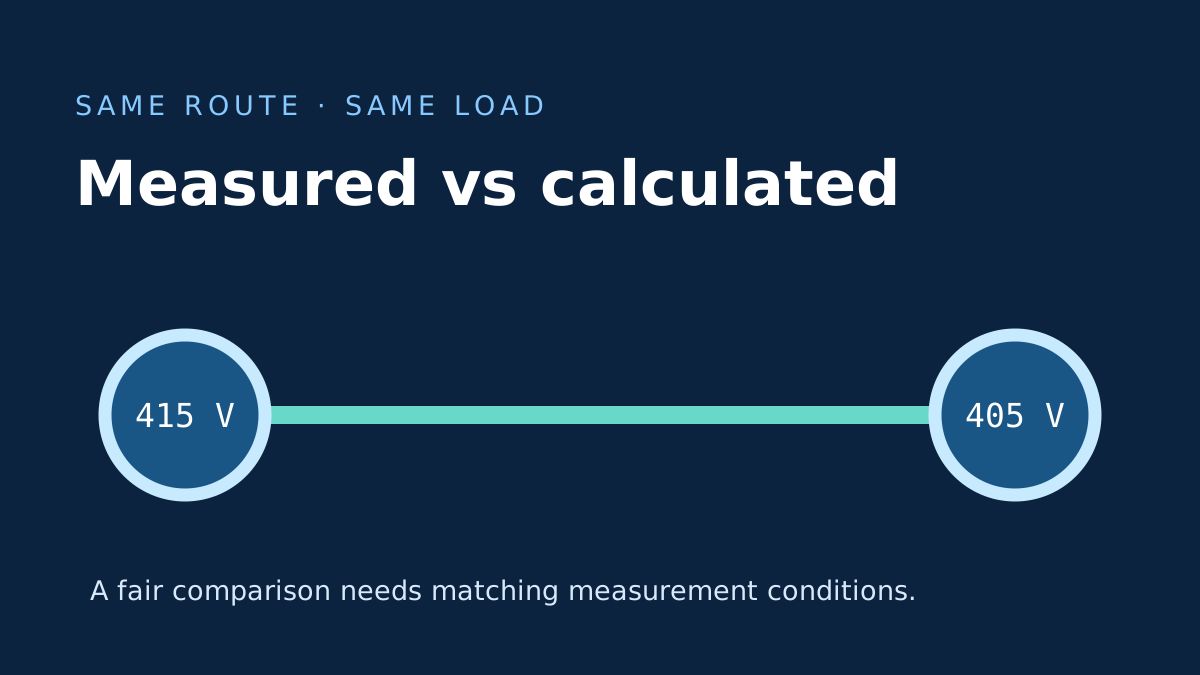
Make the two numbers comparable first
A formula predicts voltage reduction for entered conductor data and a selected load. A field measurement reflects the actual installation at a particular moment. Their difference is informative only when they refer to the same route, voltage basis and operating condition.
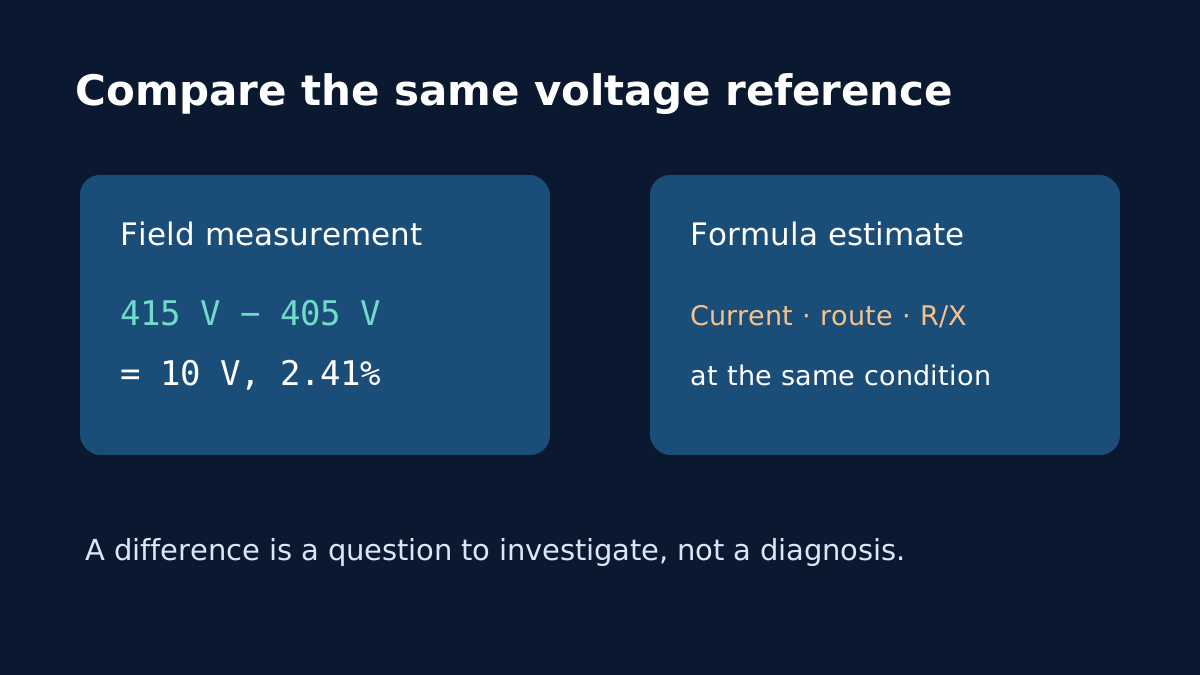
For a balanced three-phase feeder, suppose qualified personnel record 415.0 V between L1 and L2 at the source and 405.0 V between the same line pair at the load during the same steady load condition. The measured difference is 415.0 − 405.0 = 10.0 V, or 10 / 415 × 100 ≈ 2.41% of the source voltage. This is not a universal acceptable limit; it is simply the observed percentage for the stated reference.
What to enter in the calculator
The voltage-drop calculator needs one-way route length, operating current, voltage, power factor where relevant, conductor geometry and traceable R/X or mV/A/m data. An estimated conductor temperature may also matter. Use values for the actual route, not catalogue values copied from a different cable formation or temperature.
If the tool predicts 7 V while the measured difference is 10 V, do not automatically “correct” the cable resistance until the numbers match. Check that the source and load readings were effectively simultaneous, the same line pair was used, current and PF belong to that period, the route length is one-way, parallel runs are entered once, and intervening connections or equipment are understood. The R/X guide explains the impedance part.
What a mismatch cannot prove
The source voltage itself may vary while readings are taken. Load transients, unbalance, poor connections, instrument error and unmodelled route sections can all affect the comparison. A single reading does not locate a problem or establish compliance. Where abnormal heating or damage is suspected, stop treating the calculator as a diagnostic substitute and refer the installation to a qualified electrical professional.
Record the measurement points, time, load state, current on each line, voltage pair, instrument details and the data source used for the calculation. That makes the comparison reproducible instead of a dispute between two context-free numbers.
Sources and limits
Preliminary engineering aid only. Live electrical measurements must be made only by qualified people using suitable instruments and site procedures. A mismatch does not by itself identify a fault.
Verify applicable laws, standards, manufacturer data and project conditions with a qualified electrical professional before construction, procurement or regulatory submission.
CONTINUE READING
Related articles
Voltage drop and conductors
Three-Phase Voltage Drop Formula and Worked Example
A substituted example shows where √3, route length, resistance, reactance and power factor enter the result.
Voltage drop and conductors
Resistance, reactance and power factor in AC voltage drop
R and X do not contribute identically to the in-phase voltage change. Power factor sets the weighting in the common approximation.
Voltage drop and conductors
One-way route length versus total conductor length
Length errors often come from counting the return path twice. Start by identifying the geometry built into the selected formula or coefficient.