
Power and current
How to convert kW to amps for preliminary electrical work
A practical guide to the relationship between power, voltage, power factor, efficiency and line current.
Open the kW to amps calculator →Published 15 September 2026
Start with the electrical system
A kilowatt figure does not turn into one universal current value. The answer changes with the supply arrangement, voltage and, for AC loads, power factor. A 10 kW resistive load on a 230 V single-phase supply is not the same current as a 10 kW balanced load at 415 V three phase.
For DC, the basic relationship is I = P / V. For single-phase AC active power, it becomes I = P / (V × PF). For balanced three-phase AC, use line-to-line voltage: I = P / (√3 × VLL × PF).
A worked three-phase example
Take a 10 kW balanced load at 415 V with an operating power factor of 0.80:
I = 10,000 / (√3 × 415 × 0.80) = 17.39 A
If the power factor were 1.00, the current would be about 13.91 A. The active power is unchanged, but poorer power factor requires more apparent power and more line current.
Electrical input and shaft output are different
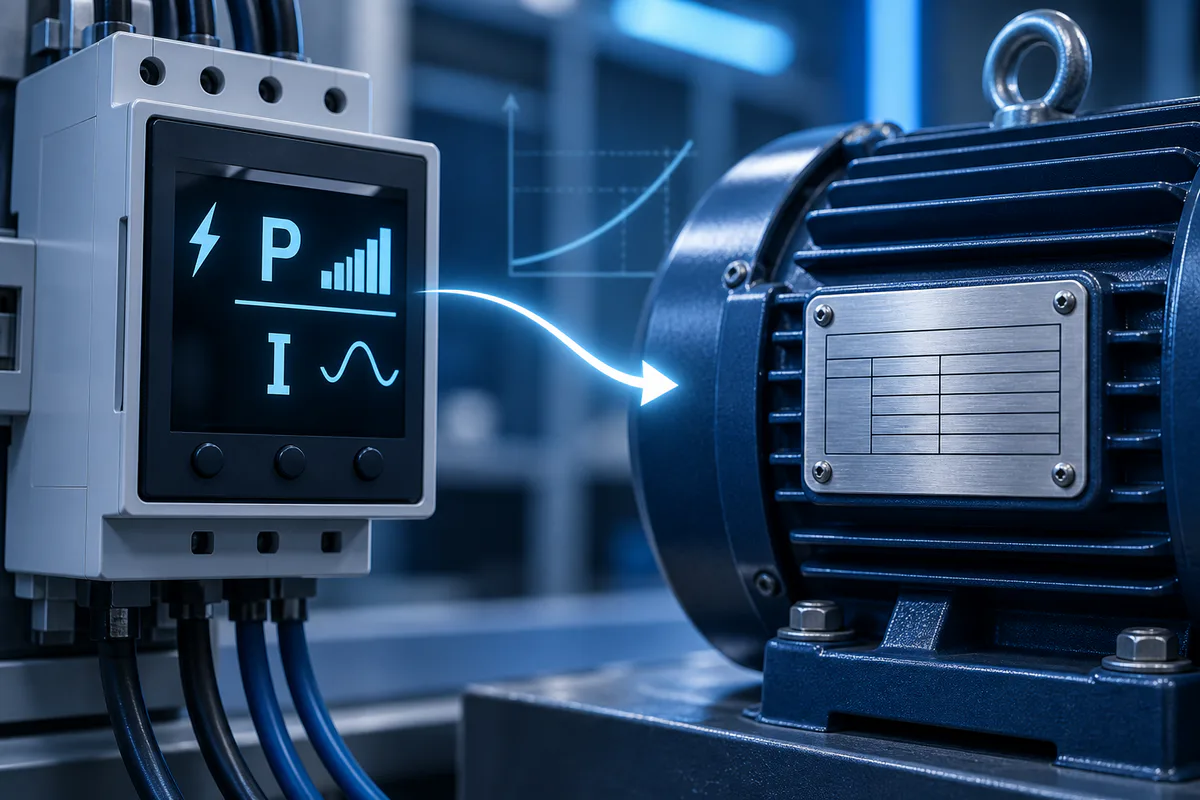
Motor ratings create an easy source of error. A mechanical horsepower or shaft-kilowatt rating describes useful mechanical output. The electrical input must also cover the machine losses. If a 10 kW shaft output is delivered at 90% efficiency, the input is 10 / 0.90 = 11.11 kW before power factor is used to estimate current.
Never apply efficiency automatically to every kW value. First identify what the rating represents. A meter reading, drive display and motor nameplate may each describe a different point in the energy path.
What to check before using the result
- Confirm whether voltage is DC, phase-to-neutral or line-to-line.
- Use an operating power factor rather than a convenient assumed value when accuracy matters.
- Keep mechanical output and electrical input clearly labelled.
- Treat the calculated current as one input to cable, voltage-drop and protection studies.
The calculator shows the substituted formula so another person can see exactly how the result was produced. That trace is more useful than a bare current figure when an assumption changes later.
Where the simple formula stops
Starting current, cyclic duty, harmonics, unbalance, drive behavior and diversity can all change the current that conductors and protection actually experience. Use equipment data and a qualified design review before turning a conversion into a purchasing or installation decision.

Sources and limits
Preliminary engineering aid only. The conversion does not determine cable size, breaker rating, fault performance, starting current or regulatory compliance.
Verify applicable laws, standards, manufacturer data and project conditions with a qualified electrical professional before construction, procurement or regulatory submission.
CONTINUE READING
Related articles
Power and current
20 kW to Amps at 415 V: Three-Phase Worked Example
At 415 V three phase, 20 kW electrical input gives 34.78 A at power factor 0.80; shaft output requires an efficiency adjustment.
Power and current
Why √3 appears in three-phase power calculations
The √3 factor is geometry, not a memorised correction. It connects phase quantities with line quantities in a balanced system.
Power and current
Horsepower to electrical input: where efficiency belongs
A motor’s shaft output is smaller than its electrical input. Correct conversion begins by identifying which side of the machine the rating describes.