
Protection and project workflow
Ib, In and Iz Worked Examples: When a Breaker Rating Fits
A 25 A breaker can fit one corrected cable capacity and fail another. Follow the numbers before interpreting the result.
Check the Ib, In and Iz relationship →Published 10 October 2026

First, identify which current belongs to which item
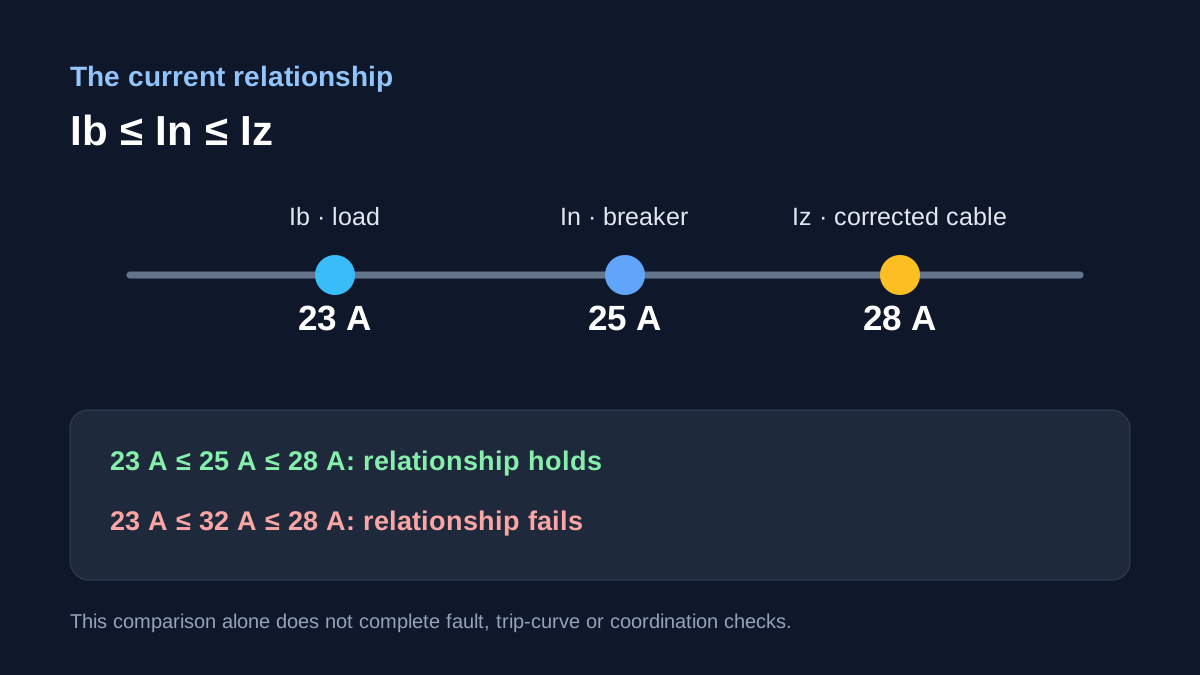
Ib is the design current of the load or circuit. In is the nominal current or relevant setting of the protective device. Iz is the current-carrying capacity of the installed cable after applicable corrections. The familiar relationship is Ib ≤ In ≤ Iz.
Those symbols are easy to remember but easy to misuse. A breaker label is not a cable rating, and a cable’s table value is not automatically its capacity in the actual installation. The Ib, In and Iz explainer gives the definitions; this page puts numbers beside them.
Open the breaker relationship helper as you work through the examples. It compares the three current values. It does not select a complete protective scheme.
Example 1: the simple relationship holds
Suppose a circuit has a design current of 23 A. A selected breaker’s nominal current is 25 A, and the corrected cable capacity is 28 A.
Ib = 23 A, In = 25 A, Iz = 28 A.
Substitution gives 23 A ≤ 25 A ≤ 28 A. The numerical ordering holds. The breaker rating is not below the design current, and the corrected cable capacity is not below the breaker rating.
This is the start of a review, not a declaration that the circuit is safe or compliant. You still need to confirm the device’s operating characteristics, prospective fault current at the installation point, breaking capacity, disconnection requirements, conductors and project conditions. The current relationship alone says nothing about those checks.
Example 2: a larger breaker breaks the ordering
Keep Ib = 23 A and Iz = 28 A, but change the breaker to In = 32 A.
The comparison becomes 23 A ≤ 32 A ≤ 28 A. Its second half is false: 32 A is greater than 28 A. The calculator should show this candidate as outside the selected relationship, even though the breaker is larger than the design load.
Increasing In can make a breaker look less likely to trip under normal load, but it also moves the device away from the cable capacity used for the comparison. Never “fix” a failed example by editing Iz to an uncorrected catalogue value. Review the cable information, installation conditions, device characteristics and design instead.
The opposite error is also possible. A 20 A nominal breaker would be below this 23 A design current. That fails the first half, Ib ≤ In, even if the cable has ample capacity.
Example 3: the correction factors change Iz
Imagine a cable record lists 40 A base ampacity under its stated reference conditions. For the intended installation, the engineer has justified two example correction factors of 0.80 and 0.80. These figures are for arithmetic illustration only; this article does not supply installation tables.
Iz = 40 A × 0.80 × 0.80 = 25.6 A.
With Ib = 23 A and In = 25 A, the comparison is now 23 A ≤ 25 A ≤ 25.6 A. The narrow current relationship still holds, with only 0.6 A between the nominal device rating and corrected cable capacity. That small margin may prompt closer review of input quality and other constraints, but no universal margin is implied by this example.
Now suppose a change of installation conditions means the justified factors are 0.70 and 0.80:
Iz = 40 A × 0.70 × 0.80 = 22.4 A.
The same 23 A design current exceeds the corrected cable capacity. Choosing a smaller breaker cannot make Ib ≤ In ≤ Iz true when Ib > Iz. The cable candidate and assumptions need a fresh assessment. Our correction-factor guide explains why each factor needs its own data source and basis.
Keep the other ratings in view
In is a current rating, not the device’s fault-current breaking capacity. Two devices with the same In can have different interruption ratings and operating curves. Read the breaking-capacity distinction before treating a nominal rating as a complete selection.
The available installation rules may require additional checks beyond the simple inequality, including device operating current and disconnection performance. A motor circuit, a long feeder and a final lighting circuit can all call for different supporting information. No single worked example replaces those design decisions.
For your own circuit, keep a short record of Ib, the source of base ampacity, every correction factor, calculated Iz, the device rating or setting, and the reason each value applies. Then compare the values in the helper and take the remaining protection checks to a qualified electrical professional.
Sources and limits
Preliminary engineering aid only. The current ordering is only a preliminary comparison. Device operating characteristics, fault protection, breaking capacity, coordination and applicable installation rules need separate professional verification.
Verify applicable laws, standards, manufacturer data and project conditions with a qualified electrical professional before construction, procurement or regulatory submission.
CONTINUE READING
Related articles
Protection and project workflow
Ib, In and Iz: the three currents in a basic breaker check
The three symbols describe load, protective device and conductor. Keeping them separate prevents circular sizing logic.
Protection and project workflow
How cable correction factors combine
Correction factors multiply. Their source conditions and applicability matter as much as the arithmetic.
Protection and project workflow
Breaker current rating is not breaking capacity
A 32 A breaker label tells you about nominal current. It does not say the device can interrupt every possible fault at that point.