
Protection and project workflow
How cable correction factors combine
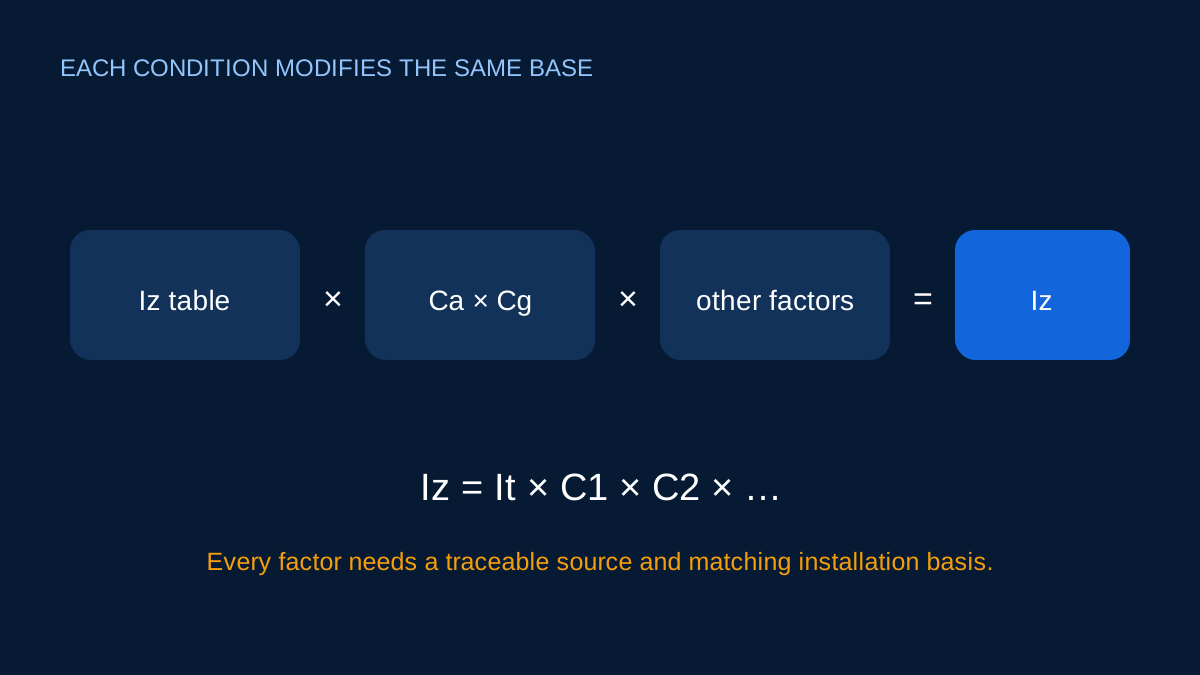
Correction factors multiply. Their source conditions and applicability matter as much as the arithmetic.
Open the custom-data cable calculator →Published 26 September 2026

What a correction factor does
Base ampacity normally belongs to stated reference conditions. An actual route may have different ambient temperature, grouping, thermal insulation, soil conditions or installation arrangements. Applicable correction factors adjust the base value to represent the assessed condition.
ElectricalDyev does not provide those factors. They must come from a source you are authorised to use and must match the cable and installation.
Multiply, do not average
If a base ampacity is 50 A and two applicable factors are 0.90 and 0.80:
Iz = 50 × 0.90 × 0.80 = 36 A
Averaging the factors would give 0.85 and a misleading 42.5 A. Adding reductions independently can also produce a different result. The factor method is multiplicative.
Work backwards when screening candidates
If design current is 32 A and the composite factor is 0.90 × 0.80 = 0.72, the required base ampacity is:
It_required = 32 / 0.72 = 44.44 A
This is useful for screening a custom candidate list. The selected base value must still come from the correct source table and reference method.
Do not multiply factors blindly
Some source methods package conditions together or define when combinations apply. A factor from one table may assume a reference condition that conflicts with another source. More factors do not automatically make a calculation safer; incompatible factors can make it meaningless.
Record the factor label, value, source, table or product reference, and why it applies. If a condition does not apply, leave it out rather than entering 1.00 with an unclear label.
Correction does not solve every cable check
Corrected ampacity is one constraint. Voltage drop may require a larger conductor on a long route. Fault thermal requirements, protection operation, terminals, parallel paths and mechanical considerations can govern independently.
Why the custom-data approach matters
Cable tables and correction factors can be licensed, product-specific and jurisdiction-dependent. Embedding an unexplained generic table would create false confidence. The calculator instead exposes the values you supply, composes them visibly and labels the result for review.
That keeps the arithmetic auditable while leaving engineering responsibility with the traceable data and the project-specific design process.
Why factors usually multiply
Correction factors commonly express the usable fraction of a reference current-carrying capacity under stated conditions. If a reference value is 50 A, an ambient factor is 0.91 and a grouping factor is 0.80, the preliminary corrected value is:
Iz = 50 × 0.91 × 0.80 = 36.4 A
Adding the factors or averaging them would not represent the successive reductions. The product in this example is 0.728, meaning 72.8% of the reference value remains under the combined model.
Do not combine factors from unrelated bases
A factor belongs to a particular table, method and set of assumptions. Mixing a base ampacity from one source with correction factors from another can create a result that neither source supports. Some published methods already incorporate particular conditions, so applying an additional factor can double-count them.
Record the reference installation method, conductor construction, number of loaded conductors, ambient or ground conditions, grouping arrangement and source revision. If any of those are unknown, label the combination unsupported rather than inventing a default.
Reverse the calculation for required table capacity
When design current is known, the minimum reference-table capacity can be estimated by dividing by the combined factor. With Ib = 30 A and combined factor 0.728:
It required = 30 ÷ 0.728 = 41.21 A
This does not select a cable on its own. It identifies the minimum base capacity needed before the same correction factors are applied. Candidate data must still match the construction and installation basis, and voltage drop or fault withstand may require a larger conductor.
Sensitivity is worth checking
When the combined factor is small, modest input changes can materially affect the required base capacity. Compare plausible installation scenarios instead of treating an early route assumption as fixed. A layout change that reduces grouping or improves ventilation can sometimes be more effective than increasing conductor size.
ElectricalDyev exposes every factor and the product so the reviewer can see what governs. The “Review required” label is essential: correct multiplication cannot make an unverified factor set authoritative.
Sources and limits
Preliminary engineering aid only. No correction-factor values are supplied by this article; use authorised, traceable data applicable to the actual cable and installation.
Verify applicable laws, standards, manufacturer data and project conditions with a qualified electrical professional before construction, procurement or regulatory submission.
CONTINUE READING
Related articles
Voltage drop and conductors
Preliminary cable sizing with your own engineering data
Cable sizing is a comparison of constraints, not a lookup of load current against one universal table.
Protection and project workflow
Ib, In and Iz: the three currents in a basic breaker check
The three symbols describe load, protective device and conductor. Keeping them separate prevents circular sizing logic.
Voltage drop and conductors
Why conductor temperature changes resistance and voltage drop
A cable’s resistance is not fixed at every temperature. Load and installation conditions influence the value used in voltage-drop and loss estimates.