
Protection and project workflow
Breaker current rating is not breaking capacity
A 32 A breaker label tells you about nominal current. It does not say the device can interrupt every possible fault at that point.
Open the preliminary breaker helper →Published 26 September 2026

Two ratings answer different questions
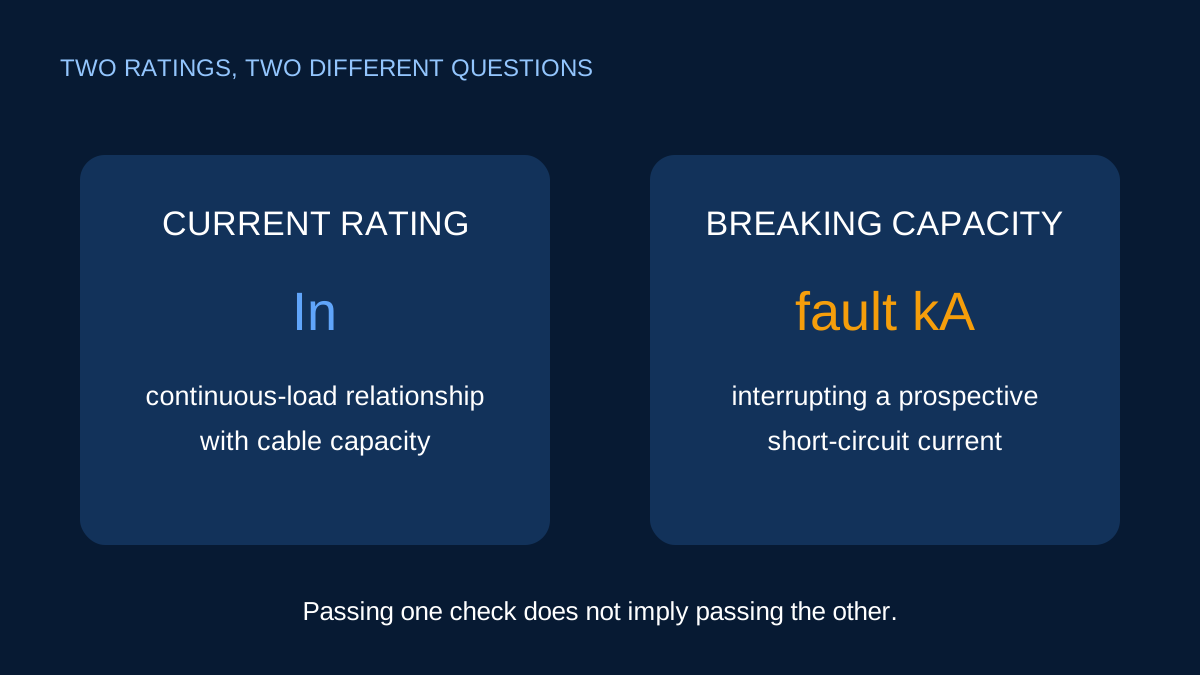
Nominal current In describes the breaker’s current rating for normal operation under its product conditions. Breaking capacity describes its ability to interrupt a specified prospective short-circuit current under defined test conditions.
Both use amperes, often with breaking capacity shown in kiloamperes, but they are not versions of the same number.
A simple example
A circuit may have design current Ib = 24 A, a 32 A nominal breaker and corrected cable capacity Iz = 38 A. The preliminary relationship 24 ≤ 32 ≤ 38 is satisfied.
Now suppose the prospective short-circuit current at the board is several kiloamperes. Nothing in the 32 A nominal rating tells you whether the device can safely interrupt that fault. You need the relevant breaking-capacity marking, product standard context and installation fault calculation.
Prospective fault current comes from the system
Fault level depends on the source, transformer rating and impedance, upstream network, conductor impedance and fault location. It is not a constant associated with the load current. Moving a breaker closer to a transformer can expose it to a higher prospective current even if the connected load is unchanged.
Device markings need context
Products can carry different short-circuit ratings and categories depending on their construction and applicable product framework. Do not compare markings by label alone or transfer a rule from one device family to another. Use the manufacturer’s documentation and the design requirements for the actual installation.
Coordination is another layer
Even when a device can interrupt the fault, the system may require selectivity with upstream or downstream protection, backup coordination, conductor energy protection and acceptable disconnection behavior. Time-current curves and manufacturer coordination data can be central to that work.
What the site deliberately does not do
The breaker helper checks only the nominal relation Ib ≤ In ≤ Iz against a rating series you provide. It does not ask for fault level and does not output breaking capacity. That boundary prevents a load-current calculation from being mistaken for a short-circuit study.
Use the helper to document an early nominal choice. Complete the fault, interruption, protection and coordination design before equipment is specified or installed.
Current rating describes the normal-current side
A breaker marked with a nominal current such as 32 A is being described partly by the current it is intended to carry under specified conditions. The actual thermal behaviour depends on device standard, curve or trip unit, ambient temperature, enclosure and manufacturer information.
The nominal rating is used in the basic Ib ≤ In ≤ Iz comparison. It does not tell you how much fault current the device can safely interrupt. Nor does it mean the device trips at exactly 32.01 A.
Breaking capacity addresses a fault event
Breaking capacity is stated in kA and must be considered against the prospective short-circuit current at the installation point under the applicable assessment method. A device with a suitable load-current rating can still be inadequate for the available fault level.
For example, a calculated design current might support considering a 32 A breaker. If the prospective fault current is several kiloamperes, a separate comparison with the device’s declared short-circuit performance is required. The 32 A label provides no answer to that comparison.
Curve and poles are not substitutes either
Trip-curve descriptions concern operating behaviour over current and time; pole configuration concerns how conductors are switched or protected. Neither is a shorthand for breaking capacity. Product families may offer several breaking capacities at the same nominal current and curve.
Read the full manufacturer marking and datasheet, including the applicable voltage and utilisation context. A screenshot or copied marketplace title is not a reliable engineering record.
Coordination expands the question
Even when an individual breaker can interrupt the local fault current, upstream and downstream devices must be considered together. Selectivity, cascading or backup arrangements, let-through energy, conductor withstand and disconnection requirements can govern the design.
ElectricalDyev deliberately does not output a breaking capacity because it does not calculate site fault level or evaluate a specific device system. Its breaker helper is a transparent screening tool for nominal current only. Retain that boundary in reports so a preliminary result cannot be mistaken for equipment approval.
Sources and limits
Preliminary engineering aid only. Only a project-specific fault and protection study using applicable product data can establish interruption and coordination suitability.
Verify applicable laws, standards, manufacturer data and project conditions with a qualified electrical professional before construction, procurement or regulatory submission.
CONTINUE READING
Related articles
Protection and project workflow
A preliminary Ib ≤ In ≤ Iz breaker relationship check
Ib, In and Iz are a useful first check, but they do not determine breaking capacity, selectivity or fault protection.
Protection and project workflow
Ib, In and Iz: the three currents in a basic breaker check
The three symbols describe load, protective device and conductor. Keeping them separate prevents circular sizing logic.
Protection and project workflow
How cable correction factors combine
Correction factors multiply. Their source conditions and applicability matter as much as the arithmetic.