
Power and current
Amps to kWh: Worked Examples at 230 V and 415 V
Amps are a snapshot of current; kWh needs active power and time. Work through one single-phase and one three-phase operating interval.
Estimate amps to kWh →Published 25 October 2026
An amp reading is not an electricity unit
An electricity “unit” on many bills means one kilowatt-hour: one kilowatt of active electrical power sustained for one hour. An ampere is current at one instant or over a short measurement window. There is no fixed amps-to-units multiplier. You need voltage, the supply arrangement, AC power factor and time.
Open the amps-to-kWh calculator with the 415 V example. It reports both the intermediate kW and the final kWh so the units can be checked.
Example 1: 230 V single phase
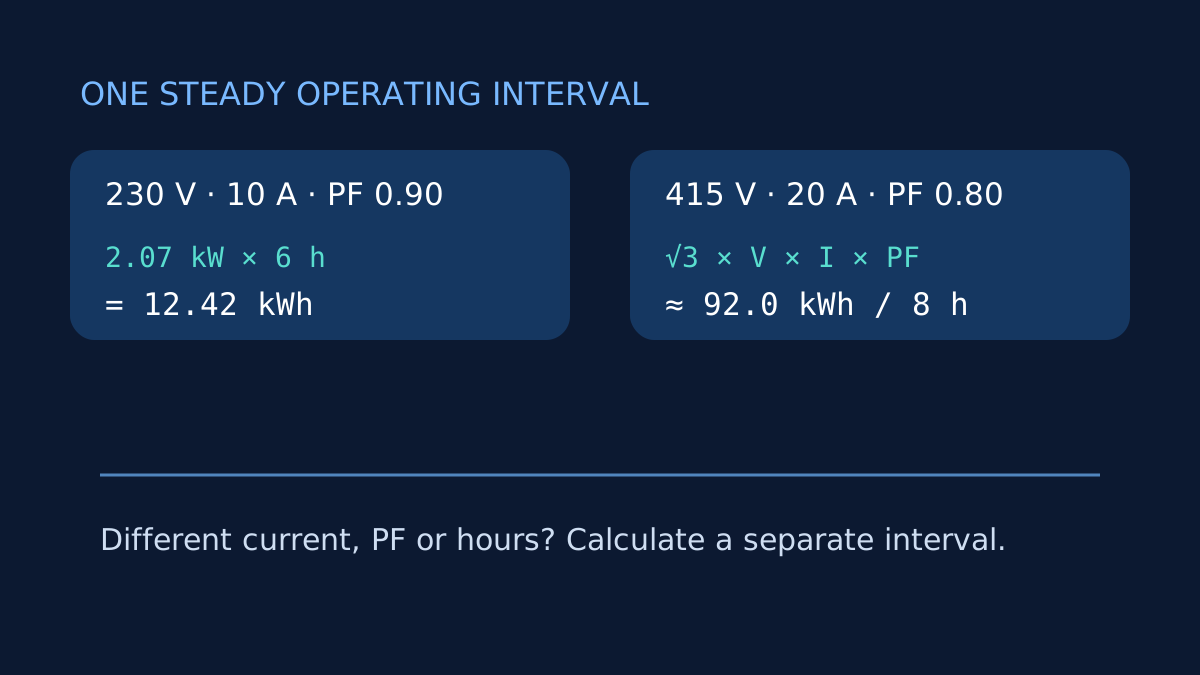
Suppose a load draws 10 A at 230 V with a measured power factor of 0.90. It operates at approximately that condition for six hours.
P = V × I × PF = 230 × 10 × 0.90 = 2,070 W = 2.07 kW
E = P × t = 2.07 kW × 6 h = 12.42 kWh
The answer is 12.42 estimated units for that six-hour interval. If the current changes, the answer changes. A 10 A reading made just as the machine starts is not a valid stand-in for six hours of operation.
Example 2: 415 V balanced three phase
Suppose each line carries 20 A, the line-to-line voltage is 415 V, and the power factor is 0.80. At this operating condition for eight hours:
P = √3 × VLL × I × PF = 1.73205 × 415 × 20 × 0.80 = 11,500 W ≈ 11.50 kW
E = 11.50 kW × 8 h ≈ 92.0 kWh
The three-phase formula uses line-to-line voltage and line current. Do not enter 415 V and then multiply by three again. The amps-to-kW examples explain the power step in more detail.
The power factor is not optional data to guess away
For AC, V × I gives apparent power, not necessarily active power. At 415 V and 20 A, apparent power is about 14.38 kVA. Multiplying by the assumed 0.80 power factor produces about 11.50 kW. Entering PF = 1 without evidence would instead estimate 14.38 kW, materially changing the eight-hour energy figure.
For a DC load, the simple steady-state relationship is P = V × I; there is no AC power-factor field. For a nonlinear AC load, a suitable power analyser or energy meter is preferable to inferring active power from a basic clamp-meter reading.
What this estimate does not say
The calculation does not know how often the equipment starts, how long it idles, whether a motor is lightly loaded, or whether the supply voltage and PF vary. It also does not know your billing rate, demand charge, taxes or meter accuracy. To model changing operation, split the day into measured intervals as described in the changing-load worksheet. For actual billed energy, use the utility or submeter reading and its measurement period.
Sources and limits
Preliminary engineering aid only. A steady-interval estimate is not a meter reading or a tariff bill. Verify voltage, current, power factor and operating duration at the same load condition.
Verify applicable laws, standards, manufacturer data and project conditions with a qualified electrical professional before construction, procurement or regulatory submission.
CONTINUE READING
Related articles
Power and current
Amps to kW: 230 V and 415 V Worked Examples
Ten amperes gives 1.84 kW at 230 V single phase or 5.75 kW at 415 V three phase when PF is 0.80.
Measurements and equipment
A Changing Load Needs More Than One Amps-to-kWh Reading
A pump that starts, idles and runs at full load does not draw one current all day. A short interval worksheet gives a more honest energy estimate.
Power and current
Does a 20 kW Motor Use 20 Electricity Units per Hour?
Twenty kilowatts on a motor is not automatically twenty kilowatt-hours on the meter every hour; rating basis and actual loading matter.