
Power and current
From clamp-meter amps to kW: worked examples at 230 V and 415 V
A current reading becomes useful power information only when voltage, phase arrangement and power factor come from the same operating condition.
Open the amps to kW calculator →Published 26 September 2026

Example one: 10 A on 230 V single phase
The active-power relationship is P = V × I × PF.
At 230 V, 10 A and power factor 0.80:
P = 230 × 10 × 0.80 = 1,840 W = 1.84 kW
At unity power factor the same voltage and current would represent 2.30 kW. This is why multiplying volts and amps without considering AC power factor can overstate active power.
Example two: 10 A on 415 V three phase
For a balanced three-phase load:
P = √3 × VLL × I × PF
At 415 V, 10 A and power factor 0.80:
P = 1.73205 × 415 × 10 × 0.80 = 5,748 W = 5.75 kW
The current is still 10 A, but the supply arrangement and voltage are different. A bare “10 A equals how many kW?” question cannot have one correct answer.
A measurement is a moment, not a rating
A clamp meter reports current at the time and conductor being measured. A compressor may cycle, a motor may be lightly loaded, and a drive may change output with process demand. If voltage and power factor are taken from nameplate values while current is measured during a different state, the estimate mixes conditions.
For three phase, one current reading also does not prove the load is balanced. Measure all phases when imbalance matters. If the waveform is distorted, use equipment suited to the waveform and the measurement purpose.
Apparent power remains useful
Single-phase apparent power is S = V × I. Balanced three-phase apparent power is S = √3 × VLL × I. In the two examples, apparent power is 2.30 kVA and 7.19 kVA respectively. Active power is apparent power multiplied by power factor.
Seeing both numbers helps explain why conductors can carry significant current even when active kW is lower than the volt-ampere product suggests.
Record enough context
Write down the measurement point, phase, voltage, operating state, current range and whether power factor was measured or assumed. For variable loads, take readings over a representative interval instead of choosing the most convenient instant.
The calculator is suitable for transparent first estimates. Use a proper power or energy measurement when billing, efficiency, harmonics, demand peaks or equipment performance depends on the answer.
Three-phase example at 415 V
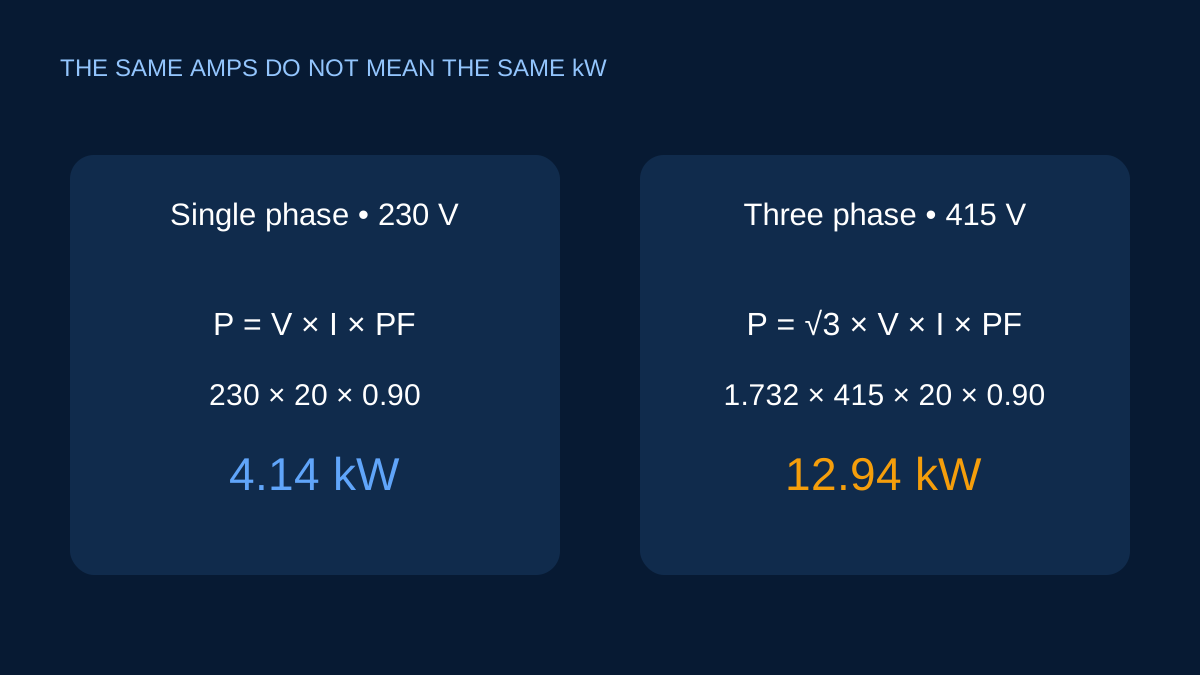
Assume a balanced three-phase load draws 20 A at 415 V line-to-line with PF 0.90. The estimated active electrical power is:
P = √3 × 415 × 20 × 0.90 = 12,938 W
or approximately 12.94 kW. At the same 20 A, changing only PF to 0.70 gives about 10.06 kW. The cable still carries 20 A in both examples, but the share of apparent power converted to active power is different.
Now compare the same current with the earlier 230 V single-phase example. At 230 V and PF 0.90, 20 A corresponds to 4.14 kW. The large difference is why a bare statement such as “the machine draws 20 amps” is not enough to estimate power.
Line-to-line voltage is the three-phase input
The balanced three-phase formula uses line-to-line voltage together with line current. In a common 415/230 V system, enter 415 V—not 230 V—when using that formula. The √3 factor links the three phase contributions and the voltage definitions.
If you enter 230 V and also keep the √3 factor, the result will be about 55% of the 415 V result. The calculator cannot infer that the wrong voltage definition was selected. Label measured values as VLL or VLN before entering them.
Current on one phase versus all phases
The balanced formula assumes all three line currents are approximately equal and the phase relationship is normal. Measuring only L1 is a quick screening step, not proof of balance. Record L1, L2 and L3 together. When they differ materially, calculate or measure the power phase by phase rather than forcing one current into a balanced equation.
Single-phase branch loads in a three-phase distribution board need different treatment. Their individual power uses the relevant line-to-neutral voltage and branch current. A load schedule can then group those circuits by phase to examine totals and imbalance.
Power is not energy
The answer is an instantaneous or steady-state power estimate in kilowatts. Energy in kilowatt-hours also depends on time and on how the load changes. A 4 kW load running for half an hour uses 2 kWh in the ideal arithmetic; a current snapshot cannot reveal that operating duration.
For energy cost, demand charges, duty cycles or efficiency studies, use a suitable meter and representative logging period. Treat the amps-to-kW conversion as a reasonableness check and a transparent bridge between measured electrical quantities—not a replacement for energy measurement.
Sources and limits
Preliminary engineering aid only. Examples assume steady sinusoidal operation and do not replace a power analyser, energy meter or phase-by-phase assessment.
Verify applicable laws, standards, manufacturer data and project conditions with a qualified electrical professional before construction, procurement or regulatory submission.
CONTINUE READING
Related articles
Power and current
How to estimate kW from amps without hiding the assumptions
Current alone is not power. Voltage, phase arrangement and power factor determine what a measured ampere value can tell you about kW.
Measurements and equipment
A clamp meter shows amps, not kW
The clamp reading is valuable, but it is one input. Voltage, phase arrangement, power factor and timing complete the power estimate.
Power and current
kW, kVA and kVAr: what each number tells you
These three quantities are related, but they answer different questions about an AC load and its effect on the supply.