
Voltage drop and conductors
What an mV/A/m value includes—and what it does not
mV/A/m is a compact voltage-drop coefficient. Its convenience depends on using the value for the exact circuit arrangement it represents.
Use the mV/A/m voltage-drop mode →Published 26 September 2026

Reading the unit literally
An mV/A/m value states how many millivolts are dropped for each ampere of load current and each metre of route, under the conditions represented by that value.
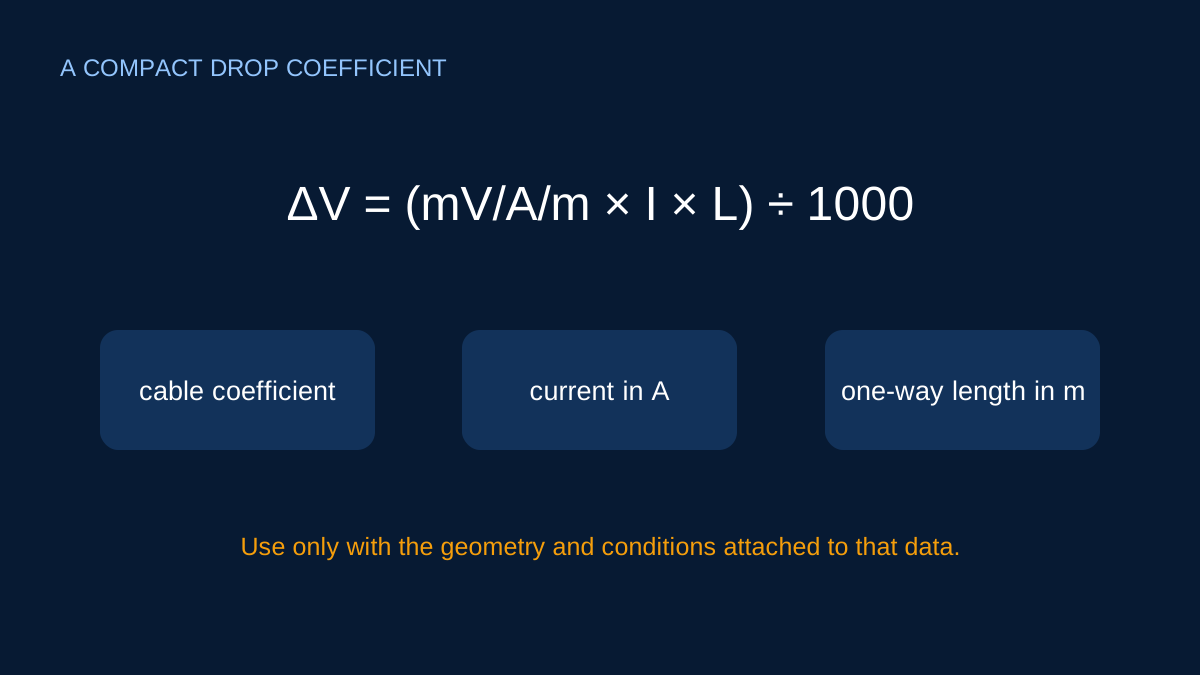
The compact calculation is:
ΔV = mV/A/m × I × L / 1,000
For 10 mV/A/m, 10 A and a 50 m route:
ΔV = 10 × 10 × 50 / 1,000 = 5 V
If the nominal voltage is 230 V, that is approximately 2.17%.
Circuit geometry is already inside the value
Published values may differ for single-phase, three-phase, multicore or spaced single-core arrangements. The coefficient often already includes the path geometry appropriate to the stated circuit. Adding another factor of two or √3 without checking the source can count the geometry twice.
That is why the calculator calls the input “phase-specific mV/A/m.” It asks you to take responsibility for matching the value to the selected circuit.
Temperature and operating assumptions
Conductor resistance rises with temperature. A source may provide values at a stated conductor operating temperature or under a particular assumption. A value taken from a cold-conductor table can understate operating drop if it is applied without adjustment.
Record the source, cable type, conductor material, size, arrangement and temperature basis. The short coefficient is useful only when those details remain attached to it.
Why loss is not reported from mV/A/m alone
Voltage drop can include both resistive and reactive contributions. A single combined mV/A/m figure does not tell the calculator how much came from conductor resistance. Reporting I²R loss would require the resistance component.
Showing 0 W would be worse: it could be read as “no loss” rather than “insufficient information.” ElectricalDyev therefore reports loss as unavailable in this mode.
Parallel paths
For an early equal-sharing model, multiple identical parallel runs reduce the effective coefficient by the number of runs. That assumption depends on matched conductors, routing and terminations. Unequal sharing needs a more detailed assessment.
Use the coefficient for its strength
mV/A/m is excellent for a quick, transparent voltage-drop check when the source value matches the installation. Use R/X data when you need the resistance and reactance contributions or a defensible loss estimate. In either case, voltage drop remains only one part of conductor selection.
Read the unit literally
The unit means millivolts of drop for each ampere of current and each metre of one-way route under the stated data conditions. Multiply the coefficient by amperes and metres, then divide by 1,000 to convert millivolts to volts.
For 10 mV/A/m, 10 A and 40 m:
ΔV = 10 × 10 × 40 ÷ 1000 = 4.0 V
At a 230 V nominal supply, that is 4 ÷ 230 × 100 = 1.74%. A result of 4,000 V means the millivolt conversion was missed. A result of 8 V may indicate that a loop factor was added even though it was already included in the coefficient.
The table heading carries engineering meaning
An mV/A/m value is not a universal property of “a 4 mm² cable”. It may depend on conductor material, construction, circuit arrangement, phase system, temperature, installation assumptions and power factor. Some sources provide separate values or columns for different conditions.
Keep the table title, row, column, revision and explanatory notes with the value. If the source does not match the intended circuit geometry, choosing a number that looks close is not a traceable calculation.
Why loss is not available from the coefficient alone
Voltage drop is related to impedance and current. Real conductor loss depends on resistance specifically: in a balanced model, terms involving I²R are used. A combined mV/A/m coefficient may include reactive contribution and geometry without exposing resistance separately.
ElectricalDyev therefore reports loss as unavailable in this mode instead of displaying 0 W. Zero would be a numeric claim that no loss exists, which is generally false. Use cable-specific resistance data when a loss estimate is required.
Parallel runs and coefficient basis
For equal parallel runs, the ideal effective drop coefficient can be divided by the number of runs, or the current per run can be used with the per-run coefficient. Apply one approach only. Confirm the source coefficient is per run rather than already describing a grouped arrangement.
Equal current sharing is an engineering assumption that needs identical conductors, route and terminations. Record it with the result and check ampacity, grouping, fault sharing and installation requirements separately.
Sources and limits
Preliminary engineering aid only. Use a value from a traceable source for the actual cable and circuit geometry; the coefficient alone cannot establish cable suitability.
Verify applicable laws, standards, manufacturer data and project conditions with a qualified electrical professional before construction, procurement or regulatory submission.
CONTINUE READING
Related articles
Voltage drop and conductors
Voltage drop: route length, conductor data and useful checks
Voltage drop is easy to calculate badly. The important work is choosing matching conductor data, geometry and route length.
Voltage drop and conductors
How far can this cable run before voltage drop exceeds the target?
Maximum route length is an inverse voltage-drop calculation, not a complete cable-sizing decision.
Voltage drop and conductors
One-way route length versus total conductor length
Length errors often come from counting the return path twice. Start by identifying the geometry built into the selected formula or coefficient.