
Voltage drop and conductors
Copper and aluminium in preliminary conductor calculations
Material changes resistance, but a practical cable choice also involves size, joints, installation, thermal behavior and product data.
Compare simplified conductor materials →Published 26 September 2026
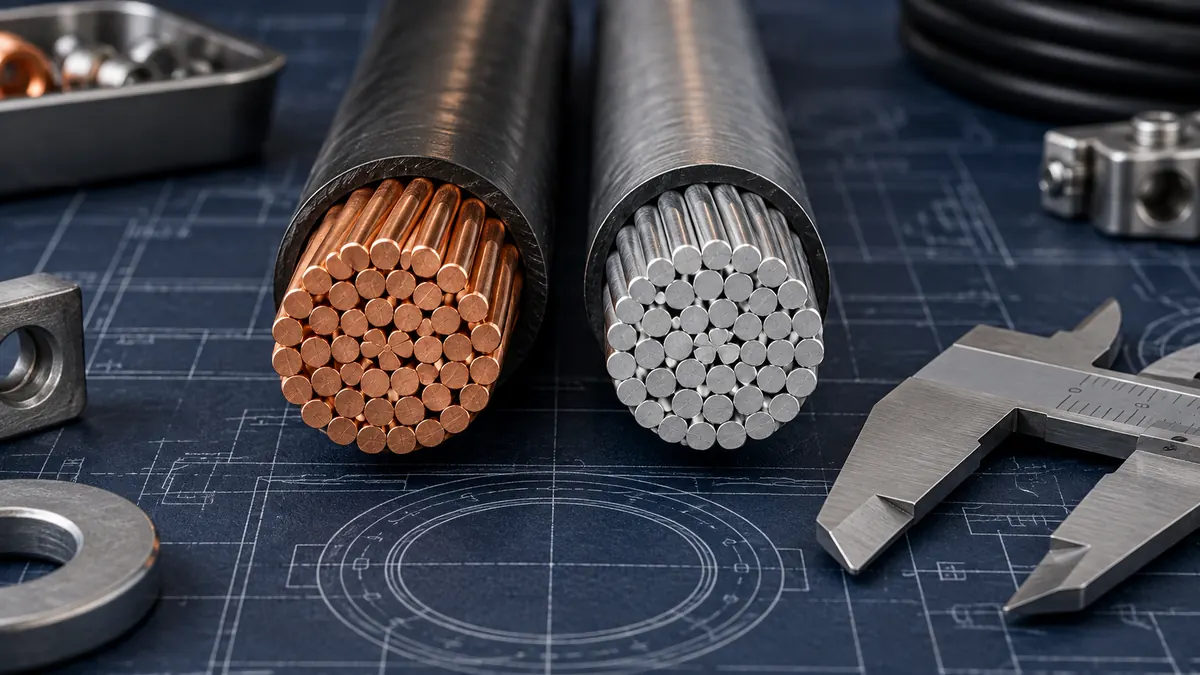
Start with resistance, not preference
For a uniform conductor in a simplified DC model:
R = ρ × L / A
Resistance depends on material resistivity ρ, length L and cross-sectional area A. Aluminium has higher resistivity than copper, so an equal-length aluminium conductor of the same area has higher resistance under the same temperature basis.
That does not make one material universally right or wrong. Designers can use a larger aluminium area, different construction or different installation choices to meet the project requirements.
A simple comparison
ElectricalDyev’s educational resistivity mode uses approximate 20°C values of 0.017241 Ω·mm²/m for copper and 0.028264 Ω·mm²/m for aluminium.
For 100 m and 50 mm²:
RCu ≈ 0.017241 × 100 / 50 = 0.0345 Ω
RAl ≈ 0.028264 × 100 / 50 = 0.0565 Ω
This isolates one property. It does not represent a full cable product, AC impedance or operating temperature.
Temperature changes both values
Resistance rises with conductor temperature. Copper and aluminium use different temperature coefficients in the simplified model. Compare materials at the same stated temperature rather than using a cold value for one and an operating value for the other.
Manufacturer data is preferable because it belongs to the actual stranded conductor and cable construction.
Connections are part of the design
Terminals, lugs, preparation methods, oxide control, tightening procedures and compatibility with equipment matter. A material that works well in the cable route still needs a suitable connection system. These are product and installation questions, not outputs of a resistivity equation.
Other practical considerations
Conductor mass, outside diameter, flexibility, available cable sizes, mechanical handling, containment space, fault performance and commercial availability can affect the choice. Ampacity and correction factors must come from appropriate traceable data for the actual cable and installation.
What the calculators can do
Simplified resistivity can show how material, area, length and temperature influence voltage drop or maximum route length. Custom R/X or mV/A/m values are better when reviewed cable-specific data is available.
Use the material comparison to understand the direction and scale of a change. Do not turn it into a procurement decision without product data, installation review and the applicable electrical requirements.
Resistivity changes the required area
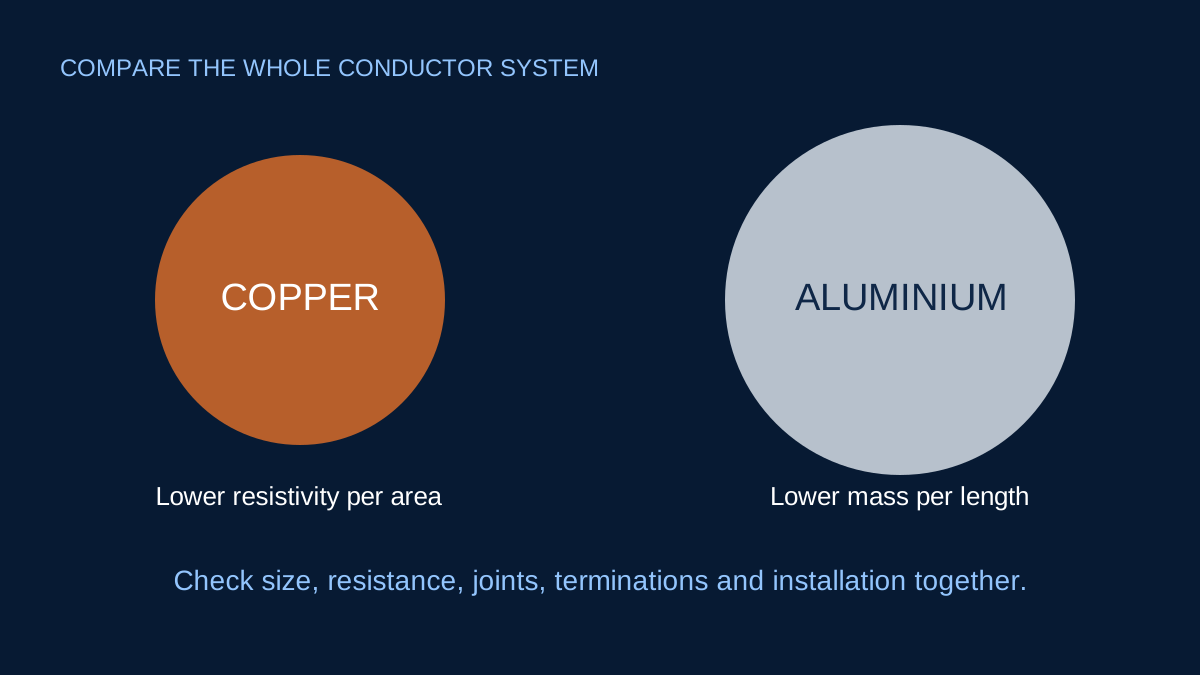
Aluminium has higher electrical resistivity than copper, so an aluminium conductor generally needs a larger cross-sectional area to achieve similar resistance. A simple room-temperature resistivity comparison can illustrate the trend, but it does not identify a commercially equivalent cable.
For a one-way 50 m single-phase route carrying 40 A, a simplified resistance model will show more drop for equal 25 mm² aluminium than equal 25 mm² copper. Increasing aluminium area can reduce that difference. The actual comparison should use cable-specific AC resistance, reactance and ampacity data at the relevant operating temperature.
Mass, diameter and route constraints
Aluminium’s lower density can reduce conductor mass, while the larger area needed for electrical performance can increase overall diameter. Bending radius, pulling tension, tray fill, duct space and support arrangements may therefore change in different directions.
A material-price comparison that ignores glands, lugs, enclosure space and installation labour is incomplete. Compare a buildable circuit solution, not only currency per kilogram or per metre.
Terminations deserve their own review
Connection hardware must be suitable for the conductor material, size and equipment terminal. Surface preparation, joint compounds where specified, tightening method and torque, thermal cycling and inspection all influence connection performance. Mixed-metal interfaces require compatible products and installation practices.
Do not assume a terminal that accepts a copper conductor automatically accepts aluminium. Use manufacturer documentation for cables, lugs, glands, terminals and equipment together. A voltage-drop calculator has no visibility into whether the chosen termination system is appropriate.
Thermal and fault performance remain separate
Corrected ampacity depends on cable construction and installation, not material resistivity alone. Short-circuit thermal withstand also uses material and insulation-specific data. Protection must coordinate with the conductor and with the actual prospective fault current.
Record why a material is being considered—mass, route length, cost, availability or another project constraint—and compare traceable candidate records on the same basis. ElectricalDyev’s custom-data workflow is designed for that transparent comparison without embedding an unverified generic table.
Sources and limits
Preliminary engineering aid only. Material comparison does not approve a conductor construction, size, termination system or installation method.
Verify applicable laws, standards, manufacturer data and project conditions with a qualified electrical professional before construction, procurement or regulatory submission.
CONTINUE READING
Related articles
Voltage drop and conductors
Why conductor temperature changes resistance and voltage drop
A cable’s resistance is not fixed at every temperature. Load and installation conditions influence the value used in voltage-drop and loss estimates.
Protection and project workflow
How cable correction factors combine
Correction factors multiply. Their source conditions and applicability matter as much as the arithmetic.
Voltage drop and conductors
Preliminary cable sizing with your own engineering data
Cable sizing is a comparison of constraints, not a lookup of load current against one universal table.